Search This Blog

Monday, June 8, 2015


News Flash: A. F. Markin Will Not Run For President In 2016    

From The American Left History Blog-June 2015

“Apparently Mister Markin is the only politician in America, or at least in the Democratic or Republican Party, who has not thrown his or her hat, or tried to throw his or her hat,  into the ring this election cycle for a chance at the brass ring, or Hillary Rodham Clinton’s big target. He must be a rare bird.”-John Stewart, WDJA News

When asked about endorsing Hilary Rodham Clinton for President A.F. Markin, at his press conference in New York City announcing his decision new where he had just announced that he would not run for the office this cycle, quoted one of his favorite old time bluesman, a man who had many problems with, wine, women and song-“I’d rather be the devil that to be that woman’s man.” Enough said.       

Media Flash: A. F. Markin, long time anti-capitalist, anti-imperialist, pro-socialist activist and the evil genius behind the blog American Left History, has announced today that under no conditions will he be a candidate for President of the United States in 2016. In prior election cycles he has run for the office as an Independent Social-Democrat (2004) and after nomination on the Green Wave Party ticket (2008, although he waged an opportunistic low-level campaign because according to one campaign worker he did not want to ruin then Senator Barack Obama’s chances at the White House expecting some kind of job offer for doing so. To once again prove that opportunism does not pay, especially for so-called principled socialists like him and Senator Bernard Sanders of Vermont, he was never offered any position in that administration). In 2012 he got “religion” and sat out the campaign not because of any thought of ruining the chances of that “miserable sell-out bastard Obama” (Markin’s words) but because he had read an obscure document based on the tenets of the Communist International (Vladimir Lenin’s old-time operation to create world revolution established in 1919 and went out of business in 1943) in a left-wing socialist newspaper which stated that socialists should not seek, not even run for, the executive offices (President, Governor, sheriff) of what they called the “bourgeois capitalist state.” Chastised, thoroughly chastised by that obscure odd-ball reference he is again sitting the 2016 election cycle out.     

At the press conference held in New York City’s Best Eastern Hotel making the announcement Markin, paraphrasing the great 19th century Northern Civil War general, William Tecumseh Sherman (hero of “Billy’s bummers traipsing through Georgia and its environs and scourge of the rebels) stated that “if drafted I will not run and if elected I will not serve” in that post. He, however, did not rule out the possibility of running for some legislative office like the United States Senate or U.S. House of Representatives. –Josh Breslin, Portland Free Press

A.F. Markin commentary on the American Politics Today website expanding on his decision not to run (originally posted on the American Left History blog on June 6, 2015):      

“I know that the long suffering readers of this blog have been waiting breathlessly for me to announce my intentions for the presidential campaign of 2016. Wait a minute! What kind of madness is this on my part to impose on readers who I am sure are still recovering from the shell-shock of that seemingly endless and mendacious 2012 presidential campaign. Well… Okay, as usual I want to, for good or ill, make a little point about running for the executive offices of the bourgeois state now that I have gotten ‘religion’ about the necessary of radicals and revolutionaries, even garden variety socialists like me, NOT to do so. I think this point can really be driven home today now that we have a ‘progressive’ Democratic president, one Barack Obama, as a foil.

I have detailed elsewhere the controversy and checkered history in the international workers movement, and especially in the Communist International in its heroic days in the early 1920's, surrounding the question of whether radicals and revolutionaries, on principle, should run for these executive offices of the bourgeois state. I need not repeat that argument here. (See June 2008 Archives, "If Drafted I Will Not Run, If Elected I Will Not Serve-Revolutionaries and Running For Executive Offices," American Left History blog, dated June 15, 2008). I have also noted there the trajectory of my own conversion to the position of opposition to such runs.

Previously I had seen such electoral efforts as good propaganda tools and/or basically harmless attempts to intersect political reality at times when the electorate is tuned in. Always under the assumption made clear during the campaign that, of course, if elected one would not assume the office.

In any case, I admit to a previously rather cavalier attitude toward the whole question, even as I began to see the wisdom of opposition. But having gone through the recent presidential campaign and, more importantly, the inauguration and installation of a ‘progressive’ black man to the highest office attainable under the imperium I have begun to wipe that smirk off my face.

Why? I have hardly been unaware throughout my leftist political career that Social Democratic and Communist (Stalinist/Maoist varieties especially) Party politicians have, individually or in popular front alliances with capitalist parties, wreaked havoc on working people while administrating the bourgeois state. I have, in particular, spent a good part of my political career fighting against the notion of popular front strategies as they have been forged in the past, disastrously in places like Spain during the Civil War in the 1930’s and Chile in 1973 or less disastrously in France in the 1980’s. However this question of the realities of running the imperial state in America really hit home with the coming into office of Barack Obama.

Certainly, Obama did not have, and in the course of such things could not have any qualms about administering the bourgeois state, even if such toilsome work contradicted his most basic principles. Assuming, for the sake of argument here, that Obama is not the worst bourgeois politician, progressive or not, that has come down the pike. Already, in a few short weeks in office, he has escalated the troop levels in Afghanistan. He is most earnestly committed to bailing out the financial heart of the imperial system, at the long term expense of working people. Where is the room for that vaunted ‘progressive’ designation in all of this? Oh yes he has is against torture and illegal torture centers. That, dear readers might have passed for progressive action- in the 17th century. Jesus, is there no end to this madness in taking grandstanding kudos for stuff that Voltaire would have dismissed out of hand. So the next time someone asks you to run for President of the United States (or governor of a state or mayor of a city) take the Markin pledge - Just say NO!

Sunday, June 7, 2015

Looking For The Heart Of Saturday Night, Christ The Heart Of Any Night-The Songs of Tom Waits-Take Five


From The Pen Of The Late Peter Paul Markin (who feel by the wayside looking too hard for his own Saturday night-RIP, Brother)     


A YouTube film clip of Tom Waits performing Looking For The Heart Of Saturday Night

If you, as I do, every once in a while, every once in a while when the norms of the today’s bourgeois-driven push, you know grab goods, grab the dough, grab some shelter from the storm, the storm that these days comes down like a hard rain falling, to get ahead in this wicked old world have to step back and take stock, maybe listen to some words of wisdom, or words that help explain how you got into that mess then you have come to the right address. Okay, okay on that bourgeois-driven today thing maybe going back further to Calvinist Puritan avenging angels times with John Winthrop and the Mayflower boys but you best ask Max Weber about that since he tried to hook the boys to the wheel of the capitalist profit, profit for you at the expense of me, system with the new dispensation coming out like hellfire from Geneva and points east and west. But you get the point.

If all that to-ing and fro-ing (nice touch, right) leaves you wondering where you fell off the edge, that edge city (edge city where you danced around with all the conventions of the days, danced around the get ahead world with blinkers on) where big cloud outrageous youthful dreams were dreamt and you took risks, damn did you take risks, thought nothing of that fact either, landed on your ass more than a few time but just picked yourself up and dusted your knees off and done stick around and listen up. Yeah, so if you are wondering,  have been pushed off your saintly wheels, yeah, pushed off your sainted wheels, and gotten yourself  into some angst-ridden despair about where you went off that angel-driven dream of your youth, now faded, tattered, and half- forgotten(but only half, only half, the wisp of the dream, the eternal peace dream, the figuring out how to contain that fire, that wanting habits fire in your belly dream sisters and brothers), and need some solace (need some way to stop the fret counting the coffee cups that while away your life), need to reach back to roots (reach back to roots that the 1950s golden age of America kicked the ass out of all the old to make us crave oneness, to forget about those old immigrant customs, made us forget that simple country blues, mountain breeze songs, cowboy ballads, Tex-Mex, Cajun Saturday night that made the people feel good times), reach back to the primeval forest maybe, put the headphones on some Tom Waits platter (oops, CD, YouTube selection, etc.- “platter” refers to a, ah, record, vinyl, put on a record player, hell, look it up in Wikipedia, okay) and remember what it was like when men and women sang just to sing the truth of what they saw and heard.

If the norms of don’t rock the boat (not in these uncertain times like any times in human existence were certain, damn, there was always something coming up from the first man-eating beast to the human race-eating nuclear bombs), the norms of keep your head down (that’s right brother, that’s right sister keep looking down, no left or rights for your placid world), keeping your head down being an art form now with appropriate ritual (that ritual looking more and more like the firing squad that took old Juan Romero’s life when he did bad those days out in Utah country), and excuses, because, well, because you don’t want to wind up like them (and fill in the blank of the “them,” usually dark, very dark like some deathless, starless night disturbing your sleep, begging, I swear, begging you to put that gun in full view on the table,   speaking some unknown language, maybe A-rab, maybe gibberish for all you know, moving furtively and stealthily against your good night) drive you crazy and you need, desperately need, to listen to those ancient drum beats, those primeval forest leave droppings maybe, that old time embedded DNA coda long lost to, oh yes, civilization, to some civilizing mission (think of that Mayflower gang or ask Max Weber), that spoke of the better angels of your nature when those angel dreams, half-forgotten but only half remember, ruled your days. Turn up the volume up another notch or two on that Tom Waits selection, maybe Jersey Girl or Brother, Can You Spare A Dime (can you?), Hold On, or Gunn Street Girl.

If you need to hear things, just to sort things out, just to recapture that angel-edge, recapture the time when you did no fear, you and everybody else’s sisters and brothers, that thing you build and from which you now should run, recapture that child-like wonder that made you come alive, made you think about from whence you came and how a turn, a slight turn this way or that, could have landed you on the wrong side. And I have the list of brothers and sisters who took that wrong road, when he wound up face down in some dusty back road arroyo down Sonora way when the deal went bust or when she, maybe a little kinky for all I know, decided that she would try a needle and a spoon, I swear, or she swore just for kicks and she wound up in Madame LaRue’s whorehouse working that bed to perdition. Hey, sweet dreams baby I tried to tell you when you play with fire, watch out.

So if you need to sort things out about boozers (and about titanic booze-crazed struggles in barrooms, on beaches, in the back seats of cars, lost in the mist of time down some crazed midnight, hell, four in the morning, penniless, cab fare-less night), losers (those who have lost their way, gotten it taken away from them like some maiden virginity), those who never had anything but lost, not those who never had a way to be lost, dopesters inhaling, in solitary hotel rooms among junkie brethren, gathering a needle and spoon in some subterranean dank cellar, down in dark alleys jack-rolling some poor drunk stiff out of his room rent for kicks (how uncool to drink low-shelf whiskeys or rotgut wines hell the guy deserved to be rolled, should feel lucky he got away with just a flipped wallet), out in nighttime canyons flame blaring off the walls, the seven seas of chemical dust, mainly blotter, maybe peyote (the sweet dreams of ten million years of ghost warriors working the layered canyon walls flickering against the campfire flames and the sight of two modern warriors ready to do justice for the white man's greed until the flames flickered out and they fell in a heap exhausted) if that earth angel connection comes through (Aunt Sally, always, some Aunt Sally coming up the stairs to ease the pain, to make one feel, no, not feel, better than any AMA doctor without a prescription pad), creating visions of long lost tribes trying, trying like hell, to get “connected,” connected in the campfire shadow night, hipsters (all dressed in black, mary mack dressed in black, speeding, speaking be-bop this and be-bop that to stay in fashion, hustling, always hustle, maybe pimping some street urchin, maybe cracking some guy’s head to create a “new world order” of the malignant, always moving), fallen sisters (sisters of mercy, sisters who need mercy, sisters who were mercifully made fallen in some mad dash night, merciful sister feed me, feed me good), midnight sifters (lifting in no particular order hubcaps, tires, wrenches, jacks, an occasional gem, some cheap jewelry in wrong neighborhoods, some paintings or whatever is not saleable left in some sneak back alley, it is the sifting that counts), grifters (hey, buddy watch this, now you see it, now you don’t, now you don’t see your long gone John dough, and Mister three card Monte long gone too ), drifters (here today gone tomorrow with or without dough, to Winnemucca, Ogden, Fresno, Frisco town, name your town, name your poison and the great big blue seas washing you clean out into the Japans ), the drift-less (cramped into one room hovels, shelters, seedy rooming houses afraid to stay in-doors or to go outside, afraid of the “them” too, afraid to be washed clean, angel clean), and small-time grafters (the ten-percent guys, failed insurance men, repo artists, bounty hunters, press agents, personal trainers, need I go on). You know where to look, right.

If you need to be refreshed on the subject of hoboes, bums, tramps (and remind me sometime to draw the distinction, the very real and acknowledged distinction between those three afore –mentioned classes of brethren once told to me by a forlorn grand master hobo, a guy down on his luck moving downward to bum), out in the railroad jungles in some Los Angeles ravine, some Gallup, New Mexico Southern Pacific  trestle (the old SP the only way to travel out west if you want to get west), some Hoboken broken down pier (ha, shades of the last page of Jack Kerouac’s classic), the fallen (fallen outside the gates of Eden, or, hell, inside too), those who want to fall (and let god figure out who made who fall, okay), Spanish Johnnies (slicked back black hair, tee shirt, shiv, cigarette butt hanging from a parted lip, belt buckle ready for action, leering, leering at that girl over there, some gringa for a change of pace, maybe your girl but watch out for that shiv, the bastard), stale cigarette butts (from Spanish Johnnie and all the johnnies, Camels, Luckies, no filters, no way), whiskey-soaked barroom floors (and whiskey-soaked drunks to mop the damn place up, for drinks and donuts, maybe just for the drinks), loners (jesus, books, big academic books with great pedigrees could be written on that subject so let’s just pass by), the lonely (ditto loners), sad sacks (kindred, one hundred times kindred to the loners and the lonely but not worthy of study, academic study anyway), the sad (encompassing all of the above) and others at the margins of society, the whole fellahin world, then Tom Waits is your stop.


Tom Waits is, frankly, an acquired taste, one listen will not do, one song will not do, but listen to a whole record (CD okay) and you won’t want to turn the thing off, high praise in anyone’s book, so a taste well worth acquiring as he storms heaven in words, in thought-out words, in cribbed, cramped, crumbled words, to express the pain, angst and anguish of modern living, yes, modern living.

See he ain’t looking for saints out there, out on the American mean streets he has pawed, maybe doesn’t believe in saints for all I know, but is out looking for busted black-hearted angels all dressed in some slinky silk thing to make man, a high-shelf whiskey man that night go off his moorings feeding her drinks and she a sponge (and who left him short one night in some unnamed, maybe nameless, gin mill when she split, after she split with the bartender who watered her drinks, hell, the thing was sweet all she needed to when he leaned into her was grab his sorry ass and get the damn wallet). Looking too, a child of the pin-up playboy 1950s, for girls with Monroe hips (hip swaying wickedly in the dead air night, and enflaming desire, hell lust, getting kicked out of proper small town hells by descendants of those aforementioned Mayflower boys promising the world for one forbidden night), got real, and got left for dead with cigar wrapping rings. Yeah, looking for the desperate out there who went off the righteous path and wound up too young face down in some forsaken woods who said she needed to hold on to something, and for all the misbegotten. 

Tom Waits gives voice in song, a big task, to the kind of characters that peopled Nelson Algren’s novels (The Last Carousel, Neon Wilderness, Walk on the Wild Side, and The Man with the Golden Arm). The, frankly, white trash Okie/Arkie Dove Linkhorns of the world who had to keep moving just for the sake of moving something in the DNA driving that whirlwind, genetically broken before they begin, broken before they hit these shores (their forbears thrown out of Europe for venal crimes and lusts, pig-stealing, deer-pouching, working the commons without a license, highwaymen, ancient jack-rollers, the flotsam and jetsam of the old world, damn them, the master-less men and women, ask old Max about them too), having been chased out, cast out of Europe, or some such place. In short, the people who do not make revolutions, those revolutions we keep hearing and reading about, the wretched of the earth and their kin, far from it, but those who surely, and desperately could use one. If you want to hear about those desperate brethren then here is your stop as well.

If, additionally, you need a primordial grizzled gravelly voice to attune your ear to the scratchy earth and occasional dissonant instrumentation to round out the picture go no further. Hey, let’s leave it at this- if you need someone who “feels your pain” for his characters you are home. Keep looking for the heart of Saturday night, Brother, keep looking.


Saturday, June 6, 2015

Sitting On The Rim Of The World- With The Son Of The Neon Wilderness Nelson Algren In Mind-Take Four


From The Pen Of Frank Jackman

He wrote of small-voiced people, mostly people who had started out in the world with small voices, small voices which never got louder, never were heard over the rumble of the subway, working stiffs and their women, sometimes their kids, their kids growing up like weeds, who turned out to be disappointments but what could expect more from the progeny of small-voiced people, guys who sat around gin mills all night (maybe all day too I knew a few who inhabited the Dublin Grille in my old hometown of North Adamsville, another town filled with small-voice people). Never wrote, or wrote much, about big-voiced people who tumbled down to the sound of rumble subway stops out their doors, people who fell off the rim of the world from some high place due to their hubris, their addictions, their outrageous wanting habits never sated before the fall (not some edenic fall but just a worldly fall that once it happened the world moved on and ignored). Wrote of the desperately lonely, a man talking to himself on some forsaken park bench the only voice, not a big voice but a voice that had to be reckoned with, of the stuffed cop swaggering his billy club menacingly to him move on, or else, a woman, unhappy in love, hell maybe jilted at the altar, sitting alone like some Apple Annie in that one Ladies Invited tavern on the corner, the one just off Division where she had met that man the first time and meets all men now, all men with the price of a drink, no more. Yeah, a big old world filled with the lonely hearing only their own heartbeats, heard no other heartbeats as they waited out their days. What did Eliot call it, oh yeah, measured out their lives in coffee spoons. Wrote of alienated people too, not the Chicago intellectuals who were forever belly-aching about the de-humanization of man, about how we had built a mechanical world from which we had to run but the common clay, the ones who manned the conveyor belts, ran the damn rumbling subways, shoveled the snow, hell, shoveled shit day and night. Wrote of the night people, of the ones who would show up after midnight in some police precinct line-up, the winos, the jack-rollers, the drifters, the grifters, the midnight sifters, maybe a hooker who had not paid the paddy and thus was subject to the grill. Wrote of the  people who inhabit the Nighthawk Diner (artist Edward Hopper’s all shape angles, all dim lights outside, bright fluorescent no privacy, no hiding lights inside, all the lonely people eating their midnight hamburgers fresh off the greased grill, another grill that forlorn hooker knew well, or Tom Waits’ rummies, bummies, stumblers, street-walkers looking for respect all shadows left behind, take your pick), the restless, the sleepless, the shiftless, those who worked the late shift, those who drew the late shift of life, those who worked better under the cover of night in the dark alleyways and sullen doorways.

He wrote big time, big words, about the small-voiced people, big words for people who spoke in small words, spoke small words about small dreams, or no dreams, spoke only of the moment, the eternal moment. The next fix, how to get it, the next drink, how to get it, the next bet, how to con the barkeeper to put him on the sheet, the next john, how to take him, the next rent due, how to avoid the dun and who after all had time for anything beyond that one moment. Waiting eternally waiting to get well, waiting for the fixer man to walk up the stairs and get you well, well beyond what any doctor could prescript, better than any priest could absolve, to get some kicks. (Needle, whiskey, sex although that was far down the list by the time that needle was needed or that shot of low-shelf whiskey drove you to your need, again.) Waiting for the fixer man, waiting for the fixer man to fix what ailed them. Not for him the small voice pleasant Midwestern farmers providing breadbaskets to the world talking to kindred about prices of wheat and corn, the prosperous small town drugstore owners filling official drug prescriptions and selling the under-aged liquor as medicine or whatever the traffic would bear, or of Miss Millie’s beauty salon where the blue-haired ladies get ready for battle and gossip about how Mister so and so had an affair with Miss so and so from the office and how will Mildred who of course they would never tell do when the whole thing goes public (although one suspects that he could have written that stuff, written and hacked away his talent)who in the pull and push of the writing profession they had (have) their muses. Nor was he inclined to push the air out of the small town banker seeking a bigger voice (calling in checks at a moment’s notice), the newspaper publisher seeking to control the voices or the alderman or his or her equivalent who had their own apparatuses for getting their small voices heard (although again one suspects he could have, if so inclined, shilled for that set). No, he, Nelson Algren, he, to give him a name took dead aim at the refuge of society, the lumpen as he put it in the title of one short story, those sitting on the rim of the world.

And he did good, did good by his art, did good by his honest snarly look at the underside of society, and, damn, by making us think about that quarter turn of fate that separated the prosperous farmer (assuming as we must that he, secretly, was not short-weighting the world), the drugstore owner (assuming as we must that he, secretly, was not dispensing his wares, his potent drugs, out the back door to a craving market) , Miss Millie (assuming as we must that she, secretly, was not running a call girl service on the side), the banker (assuming as we must that he, maybe secretly maybe not, was not gouging rack rents and usurious interest), the newspaper editor (assuming as we must that he, very publicly, in fact was printing all the news fit to print), and the politician (assuming as we must that he, secretly, was not bought and paid for by all of the above, or others) from the denizens of his mean streets. The mean city streets, mainly of Chicago, but that is just detail, just names of streets and sections of town to balance his work where his characters eked out an existence, well, anyway they could, some to turn up face down in some muddy ravine, under some railroad trestle, in some dime flop house, other to sort of amble along in the urban wilderness purgatory.

Brother Algren gave us characters to chew on, plenty of characters, mostly men, mostly desperate (in the very broadest sense of that word), mostly with some jones to work off, mostly with some fixer man in the background to wreak havoc too. He gave us two classics of the seamy side genre, one, the misbegotten Frankie Machine, the man with the golden arm, the man with the chip on his shoulder, the mid-century(20th century, okay) man ill at ease in his world, ill at ease with the world and looking, looking for some relief, some kicks in that mid-century parlance, and, two, that hungry boy, that denizen of the great white trash night, Dove Linkhorn, who, perhaps more than Frankie spoke to that mid-century angst, spoke to that world gone wrong, for those who had just come up, come up for some place where time stood still to gain succor in the urban swirl, to feast at the table, come up from the back forty lots, the prairie golden harvest wheat fields, the Ozarks, all swamps and ooze, mountain wind hills and hollows, the infested bayous and were ready to howl, howl at the moon to get attention.

I remember reading somewhere, and I have forgotten where now, that someone had noted that Nelson Algren’s writing on Dove Linkhorn’s roots was the most evocative piece on the meaning of the okie–arkie out migration segment of that mid-century America ever written, the tale of the wandering boys, the railroad riders, the jungle camp jumpers, the skid row derelicts. Hell, call it by its right name, the white trash, that lumpen mush. And he or she was right, of course, after I went back and re-read that first section of Walk On The Wild Side where the Linkhorn genealogy back unto the transport ships that brought the first crop of that ilk from thrown out Europe are explored. All the pig thieves, cattle-rustlers, poachers, highwaymen, the -what did some sociologist call them?, oh yeah, “the master-less men,” those who could not or would not be tamed by the on-rushing wheels of free-form capitalism as the system relentlessly picked up steam, the whole damn lot transported. And good riddance.

The population of California after World War II was filled to the brim with such types, the feckless “hot rod” boys, boys mostly too young to have been though the bloodbaths of Europe and Asia building some powerful road machines out of baling wire and not much else, speeding up and down those ocean-flecked highways looking for the heart of Saturday night, looking for kicks just like those Chicago free-flow junkies, those twisted New Orleans whoremasters. Wandering hells angels riding two by two (four by four if they felt like it and who was to stop them) creating havoc for the good citizens of those small towns they descended on, descended on unannounced (and unwelcomed by those same good citizens). In and out of jail, Q, Folsom, not for stealing pigs now, but armed robberies or some egregious felony, but kindred to those lost boys kicked out of Europe long ago. Corner boys, tee-shirted, black leather jacket against cold nights, hanging out with time on their hands and permanent smirks, permanent hurts, permanent hatreds, paid to that Algren observation. All the kindred of the cutthroat world, or better “cut your throat” world, that Dove drifted into was just a microcosm of that small-voiced world.

He spoke of cities, even when his characters came fresh off the farm, abandoned for the bright lights of the city and useless to that short-weighting farmer who now is a prosperous sort, making serious dough as the breadbasket to the world. They, the off-hand hot rod king, the easy hell rider, the shiftless corner boy, had no existence, no outlets for their anger and angst, in small towns and hamlets for their vices, or their virtues, too small, too small for the kicks they were looking for. They needed the anonymous city rooming house, the cold-water flat, the skid- row flop house, the ten- cent beer hall, hell, the railroad jungle, any place where they could just let go with their addictions, their anxieties, and their hunger without having to explain, endlessly explain themselves, always, always a tough task for the small-voiced of this wicked old world. They identified with cities, with city 24/7/365 lights, with Algren’s blessed neon lights, city traffic (of all kinds), squalor, cops on the take, cops not on the take, plebeian entertainments, sweat, a little dried blood, marked veins, reefer madness, swilled drinks, white towers, all night diners (see it always comes back to that lonely, alienated Nighthawk Diner just ask Waits), the early editions (for race results, the number, who got dead that day, the stuff of that world), a true vision of Edward Hopper’s Nighthawk for a candid world.

He spoke of jazz and the blues, as if all the hell in this wicked old world could be held off for a minute while that sound sifted thought the night fog air reaching the rooming house, the flop, the ravine, the beer hall as it drifted out to the river and drowned. Music not upfront but as a backdrop to while the steamy summer nights away, and maybe the frigid lake front winter too. Strangely, or maybe not so strangely, he spoke of a small-voiced white world, residents of white slums and pursuers of white- etched dreams and only stick character blacks but his beat, his writing rhythm made no sense without the heat of Trouble In Mind or that cool blast of Charlie Parker, Miles, Dizzie be-bopping, made absolutely no sense, and so it went.

He spoke of love too. Not big flamed love, big heroes taking big falls for some hopeless romance like in olden times but squeezed love, love squeezed out of a spoon, maybe, but love in all its raw places. A guy turning his woman into a whore to feed his endless habit love, and her into a junkie love. A woman taking her man through cold turkey love. A man letting his woman go love, ditto woman her man when the deal went wrong. When the next best thing came by. Not pretty love all wrapped in a bow, but love nevertheless. And sometimes in this perverse old world the love a man has for a woman when, failing cold turkey, he goes to get the fixer man and that fixer man get his woman well, almost saintly and sacramental. Brothers and sisters just read The Last Carousel if you want to know about love. Hard, hard love. Yah, Nelson Algren knew how to give voice, no holds barred, to the small-voiced people.

Friday, June 5, 2015

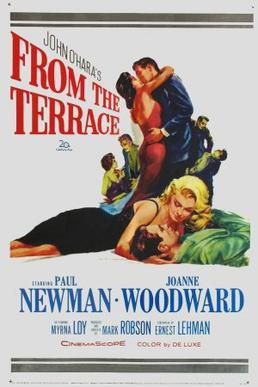
In The Age Of “Mad Men”-Paul Newman and Joanne Woodward In John O’Hara’s From The Terrace   


DVD Review

From The Pen Of Frank Jackman  

From The Terrace, starring Paul Newman, Joanne Woodward, Ina Balin,     


Sometimes, and it is the case here with the adaptation of John O’Hara’s saucy melodrama From The Terrace, a film, an older film, can provide a glimpse of what was going on in society at the time for both those who lived through it and those too young to have known about the times first hand. Part of the success of the recently ended series, Mad Men, was that viewers were interested in taking a retro look back at the early 1960s before the big counter-cultural splash tore American society asunder. You know the age of Ike, the age of conformity, and in retrospect the “golden age” of the American worker before the “race to the bottom” hit full stride. From The Terrace covers a lot of that same territory, the part about making it big in America, about making a name for yourself with hard work, ruthlessness, and some chutzpah. Some of that ethos obviously still exists now but the “rewards” for many, like the protagonist of this film, Alfred Eaton (played by Paul Newman) have lost their luster.            

Here is the skinny. In the age of Ike (and you knew you were in the age of Ike with all the guys, the Wall Street guys anyway, wearing soft hats to work and expensive nicely tailored overcoats in inclement weather to boot) there was money and reputation to be made by those men who survived the rigors of World War II (and it was mainly men since women were expected to stay home with the kids in Middle America or as in this film with Mary, Alfred’s initial love interest played by Joanne Woodward , spend their time looking beautiful if from the upper crust) and had a little luck and skill. That was the case with one Alfred Eaton who wanted to get out from under plodding along working his way up in his father’s mill (and his father’s obsession with a dead brother to the exclusion of any human feeling for him). And so he goes out on his own, first with a fellow veteran in an aircraft business then after a fortuitous event a high end job at a big time Wall Street financial firm with nothing to stop him from rising to the top except his own desires. 

Typical Wall Street success story, right? Well yes but remember this is a John O’Hara story. O’Hara cut his teeth on chronicling the lives, read sex lives, of the upper crust in places like Pennsylvania and New York  beginning with his classic Appointment at Samarra so that is not the end of the tale by any means. Of course there has to be a love interest or here more than one. Number one is the classic match-up of the “unapproachable” rich girl of Alfred’s dreams (and entre into high society) whom he is able to seduce and marry. But a guy on the way up has to give up things, mostly time for personal relationships and so Mary gets short shrift. But Mary is a fussy young woman and wants companionship anyway she can get it once it is clear that Alfred is driven by success and not by her bedroom eyes. So she wanders, works her way into a little off-hand adultery. Of course that is a problem, a big problem in publicity conscious 1950s high finance where formally stable marriages are a given. Divorce and known adultery are the kiss of death for the young and ambitious on that high road to success whatever else is involved. So Alfred is a very unhappy man who knows he has made a wrong choice in the wife department.            

And not just in the wife department as the story unfolds since he begins to have a personal crisis of conscience brought on by an attraction to a gal from Podunk (played by Ina Balin) whose wholesomeness and grounded-ness contrasts with Alfred’s whole bloody lifestyle. But our boy gets “religion,” gets it big when he has the brass ring right in his fingers-and just walks away, walks away the “Street” for whatever bucolic life is in store for him. Mary, well, the Marys of the world land on their feet so don’t cry for her. If you want a glimpse at what high society, its mores, and its hypocrisies looked in the 1950s including now seemingly strange ideas about marriage, divorce, ethical standards and just doing the right thing this while not a great story line when the deal goes down since it was not a great O’Hara story but one in a line of many along the same lines will give you an idea.             

Our Lady Of The Hills And Hollows-Jean Ritchie Passes At 92


Below is a segment from an entry I wrote for the American Folk Music blog discussing the roots of a city boy, me, and my relationship with the hills and hollows of Appalachia with which the late folksinger Jean Ritchie was so closely associated in her music:  

“What has gotten me into this reflective state is thinking about my father's background of coming from the hard-scrabble hills of Kentucky. That, my friends, means coal country, or it did in his time. The names Hazard, near Harlan County (the next county over to be exact) but, more appropriately "bloody Harlan" have, I hope, echoed across this series as a symbol for the hard life of many generations of workers and hard-scrabble tenant farmers who came out of those hills-some place. Some place in Appalachia, that is.

I have mentioned my father and his trials and tribulations, previously, when I did a series on the evolution of my youthful political trajectory from liberalism to socialism.  His hard-bitten, no breaks, no luck life was not a direct influence on that evolution, that is for sure. He was a strong anti-communist, if only of the reflexive kind coming out of that so-called “greatest generation” who survived the Great Depression of the 1930s and then, rifle over one shoulder, fought in the hellish Pacific as a Marine in all their battles there in World War II. But something in the genes and in his character left an imprint. Let me sum up his life's experience this way- the tidbit that he imparted to me early on in life I will always remember and is probably why I am still struggling for our socialist future to this day.

My father was certainly no stranger to hard times as a youth thrown into the coal mines early (or, as it turned out, in his work travails as an adult). My father, perhaps like yours, was a child of the Great Depression of the 1930's, scratching and clawing his way from pillar to post and entered into his manhood as a Marine in combat in World War II. Hard combat in the Pacific, and as anyone who has studied the period will know, where no quarter was given, or taken. Those two facts are important. Why? As a very young kid I asked him why he became a soldier, excuse me, a Marine. Well, the short answer was this- between the two alternatives, starve or fight, he was glad, no more than glad he was ecstatic, to quickly sign up at the Marine recruiting station in order to get out of the hills of Kentucky. And he, moreover, whatever happened later, never looked back.

That, my friends, is why I entitled part of the headline to today's entry- "at one remove". Those hills are in my blood, no question, no question now as much as I might have resisted such feelings before, but also the notion that those terrible choices had to be made by an honest working-class stiff. And that is why today I am in this mood thinking about how desperately we need to get down that socialist road. Pronto. And why I hear Jean Ritchie’s voice singing of her own longings in The Hills of Home, my father’s hills, as I write this, down deep in my own being.”


The Sun Sets On The British Empire-Dame Judith Dench’s The Best Exotic Madrigal Hotel


DVD Review

From The Pen Of Frank Jackman

The Best Exotic Madrigal Hotel, starring Dame Judith Dench, Maggie Smith, Dev Patel, 2012  


In the days of the Raj, in the days when the British ruled India with an iron fist, a massive naval fleet at the ready, and footloose soldiers of fortune (or rather of no fortune since the eldest son took all the dough and land and left younger brothers to the universities, the clergy, the civil service and the army) no one from the imperial center would have thought to retire to that benighted country. Rather they would spent their youth grabbing whatever they could grab and retire back in the old country in some at least modest splendor. Ah, but times have changed and John Bull has hit upon tough times as the denizens of this witty and thoughtful film demonstrate. Now the average Brit seeing his or her life circumstances at home reduced looked to the new emerging economic engine of the 21st century the old Raj to make ends meet, or to just get away from the stale life in the home country. 

Of course the setting of this film in the old Raj, and in an old hotel that had seen better days with a cast of wayward elderly ex-patriates and a wacky entrepreneurial Indian allows the director and scriptwriter to investigate all kinds of subjects from multiculturalism to haughty vestiges of the old Empire refracted through new India, ageism, sexual impulses about the older set, adjusting (or not) to a new culture, old school closeted gayness, stale marriages, failed marriages and the aches and pains of growing old wherever you find yourself marooned. Somebody had to tell the story though and that is done through the thoughts of the narrator Mrs. Greensleeves (played by Dame Judith Dench) who had gone off to India to live cheaply since her late husband did not provide enough to keep her going, and to find herself of course. Along the way she does so although not without the usual problems of those who were sheltered from the world by old school marriage when hubby did, or didn’t, take care of everything. She finds herself, her presence helps a husband caught in a horrible and stale marriage find himself (and indirectly that scorned wife as well), helps a lonely old man finds love, helps a lonely old women continuing to hope to find love, and helps the Indian innkeeper to stand up for himself against the old India represented by his old-fashioned mother. All wrapped up in the bow of a hotel that had seen better days, and all relationships filled with if not happy endings at least hope as they fade. A feel good movie with a great ensemble cast well worth a couple of hours of your time.             

Songs To While Away The Class Struggle By- We Want The World And We Want It Now 


Peter Paul Markin comment September 2014:

A while back, maybe a half a decade ago now, I started a series in this space that I presented under the headline Songs To While Away The Class Struggle By where I posted some songs, you know, The Internationale, Which Side Are You On?, Viva La Quince Brigada, Solidarity Forever and others like Deportee, Where Have All The Flowers Gone, Blowin’ In The Wind, This Land Is Your Land  while not as directly political had their hearts in the right place, that I thought would help get us through the “dog days” of the struggle for our socialist future. Those “dog days” in America anyway, depending on what leftist political perspective drove your imagination could have gone back as far as the late 1960s and early 1970s when all things were possible and the smell of revolution could be whiffed in the air for a while before we were defeated, or maybe later when all abandoned hope for the least bit of social justice in the lean, vicious, downtrodden Reagan years of unblessed memory or later still around the time of the great world- historic defeats of the international working class in East Europe and the former Soviet Union which left us with an unmatched arrogant unipolar imperialist world. That one pole being the United States, the “heart of the beast” from which we work. Whatever your personal benchmark they were nevertheless if you had the least bit of political savvy clearly dog days.        

I began posting these songs at a time, 2009, when it was touch and go whether there would be some kind of massive uprising against the economic royalists (later chastised under the popular sobriquet “the one-percent”) who had just dealt the world a blow to the head through their economic machinations in what is now called the Great Recession of 2008. Subsequently, while there were momentary uprisings, the Arab Spring which got its start in Tunisia and Egypt and enflamed most of the Middle East one way or another, here in America the defensive uprising of the public workers in Wisconsin and later the quick-moving although ephemeral Occupy movement, and the uprisings in Greek, Spain and elsewhere in Europe in response to the “belt-tightening" demanded by international financial institutions to name a few, the response from the American and world working classes has for lots of reasons if anything further entrenched those interests.

So as the “dog days” continue I have resumed the series. I do not vouch for the political thrust of the songs selected; for the most part they are done by pacifists, social democrats, hell, even just plain old ordinary democrats. And, occasionally, a communist, although hard communist musicians have historically been scarce on the ground. Thus, here we have a regular "popular front" on the music scene. While this kind of formation would mean political death for any serious revolutionary upheaval and would not be acceptable for our political prospects, it will suffice for our purposes here.

I like to invite others to make additional comments on certain pivotal songs, groups and artists and here is one by my old friend Josh Breslin, whom I met out in California during the heyday of the summer of love 1967, that reflects those many possibilities to “turn the world upside down” back in the 1960s and early 1970s mentioned earlier before the “night of the long knives” set in:

WE WANT THE WORLD AND WE WANT IT NOW!

From The Pen Of Joshua Lawrence Breslin

My old friend from the summer of love 1967 days, Peter Paul Markin, always used to make a point then of answering, or rather arguing which tells a lot about the kind of guy he was when he got his political hind legs up with anybody who tried to tell him back in the day that “music is the revolution.”  Strangely when I first met him in San Francisco that summer you would have been hard-pressed to tell him that was not the case but after a few hits on the head by the coppers, a tour of duty in the military at the height of the Vietnam War, and what was happening to other political types trying to change the world for the better like the Black Panthers he got “religion,” or at least he got that music as the agency of social change idea out of his head.  Me, well, I was (and am not) as political as Markin so that I neither got drowned in the counter-culture where music was a central cementing act, nor did I  have anything that happened subsequently that would have given me Markin’s epiphany.

I would listen half-attentively (a condition aided by being “stoned” a lot of the time) when such conversations erupted and Markin drilled his position. That position meaning, of course that contrary to the proponents (including many mutual friends who acted out on that idea and got burned by the flame, some dropping out, some going back to academia, some left by the wayside and who are maybe still wandering) that eight or ten Give Peace A Chance, Kumbaya, Woodstock songs would not do the trick, would not change this nasty, brutish, old short-life world into the garden, into some pre-lapsian Eden. Meaning that the gathering of youth nation unto itself out in places like Woodstock, Golden Gate Park, Monterrey, hell, the Boston Common, or even once word trickled down the way the word has always trickled down to the sticks once the next new thing gets a workout, Olde Saco Park, in the town up in Maine where I grew up would not feed on itself and grow to such a critical mass that the quite nameable enemies of goodness, kindness starting with one Lyndon Johnson and one Richard M. Nixon and working down to the go-fers and hangers-on, and leave us alone would sulk off somewhere, defeated or at least defanged.

Many a night, many a dope-blistered night before some seawall ocean front Pacific Coast campfire I would listen to Markin blast forth against that stuff, against that silliness. As for me, I was too “into the moment,” too into finding weed, hemp, mary jane and too into finding some fetching women to share it with to get caught up in some nebulous ideological struggle. It was only later, after the music died, after rock and roll turned in on itself, turned into some exotic fad of the exiles on Main Street that I began to think through the implications of what Markin, and the guys on the other side, were arguing about.

Now it makes perfect sense that music, or any mere cultural expression standing alone, would be unable to carry enough weight to turn us back to the garden (I won’t use that “pre-lapsarian" again to avoid showing my, and Markin’s, high Roman Catholic up-bringing and muddy what I want to say which is quite secular). I guess that I would err on the side of the “angels” and at least wish that we could have carried the day against the monsters of the American imperium we confronted back in the day. (Although I had a draft deferment due to a serious physical condition, not helped by the “street” dope I was consuming by the way, I supported, and sometimes vehemently and with some sense of organization, a lot of the political stuff Markin was knee deep into, especially the Black Panther defense when we lived in Oakland and all hell was raining down on the brothers and sisters.)                  

Thinking about what a big deal was made of such arguments recently (arguments carried deep into the night, deep in smoke dream nights, and sometimes as the blue–pink dawn came rising up to smite our dreams) I thought back to my own musical appreciations. In my jaded youth (if one could be jaded in Podunk Olde Saco, although more than one parent and more than one teacher called me “beatnik” back then whatever that meant to them) I developed an ear for roots music, whether I was conscious of that fact or not. Perhaps it was some off-shoot DNA thing since my people on my mother’s side (nee LeBlanc) were French-Canadian which had a deep folk heritage both up north and here although such music was not played in the house, a house like a lot of other ethnics where in the 1950s everybody wanted to be vanilla American (Markin mentioned that same thing about his Irish-etched parents). So it initially started as a reaction to my parents’ music, the music that got them through the Great Depression of the 1930s and later waiting for other shoe to drop (either in Normandy where my father first went to Europe under some very trying conditions or at home waiting in Olde Saco like my mother), and that became a habit, a wafting through the radio of my childhood home habit. You know who I mean Frank (Sinatra for the heathens), Harry James, the Andrews Sisters, Peggy Lee, Doris Day and the like. Or, maybe, and this is something that I have come closer to believing was the catalyst along with the DNA stuff I already mentioned, my father’s very real roots in the Saturday night mountain barn dance, fiddles blazing, music of his growing up poor down in Appalachia. (Again such music except every once in a while Hank Williams who I didn’t know about at the time was not played in the house either. Too “square” I guess.) 

The origin of my immersion into roots music first centered on the blues, country and city with the likes of Son House(and that raspy, boozy country voice on Death Letter Blues), Skip James ( I went nuts over that voice first heard after he had been “discovered” at the Newport Folk Festival I think in 1963 when he sang I’d Rather Be The Devil Than Be That Woman’s Man on the radio after I had just broken up with some devil woman, read girl), Mississippi John Hurt (that clear guitar, simple lyrics on Creole Belle), Muddy Waters (yes, Mannish-Boy ), Howlin’ Wolf ( I again went nuts when I heard his righteous Little Red Rooster  although I had heard the Stones version first, a version originally banned on Boston radio if you can believe that ) and Elmore James ( his Dust My Broom version of the old Robert Johnson tune I used to argue was the “beginning” of rock and roll to anybody who would listen). Then early rock and roll, you know the rockabillies and R&B crowd, Elvis (stuff like One Night With You, Jailhouse Rock and the like before he died in about 1958 or whatever happened to him when he started making stupid movies that mocked his great talent making him look foolish and which various girlfriends of the time forced me to go see at the old Majestic Theater in downtown Olde Saco), Jerry Lee (his High School Confidential, the film song, with him flailing away at the piano in the back of a flat-bed truck blew me away  although the film was a bust, as was the girl I saw it with), Chuck (yeah, when he declared to a candid  world that while we all gave due homage to classical music in school Mister Beethoven and his brethren better move on over with Roll Over Beethoven), Roy (Roy the boy with that big falsetto voice crooning out Running Scared, whoa), Big Joe (and that Shake, Rattle and Roll which I at one point also argued was the “beginning” of rock and roll, okay, I liked to argue those fine points)   and Ike Turner (who I ultimately settled on with his Rocket 88 as that mythical beginning of rock and roll). Then later, with the folk revival of the early 1960’s, the folk music minute before the British invasion took a lot of the air out of that kind of music, especially the protest to high heaven sort, Bob Dylan (even a so-so political guy like me, maybe less than so-so then before all hell broke loose and we had to choose sides loved Blowin’ in the Wind), Dave Von Ronk (and that raspy old voice, although he was not that old then sing Fair And Tender Ladies  one of the first folk songs I remember hearing) Joan Baez (and that long ironed-hair singing that big soprano on those Child ballads), etc.

I am, and have always been a city boy, and an Eastern city boy at that. Meaning rootless or not meaningfully or consciously rooted in any of the niches mentioned above. Nevertheless, over time I have come to appreciate many more forms of roots music than in my youth. Cajun, Tex-Mex, old time dust bowl ballads a la Woody Guthrie, cowboy stuff with the likes of Bob Wills and Milton Brown, Carter Family-etched mountain music (paying final conscious tribute to the mountain DNA in my bones) and so on.

All those genres are easily classified as roots music but I recall one time driving Markin crazy, driving him to closet me with the “music is the revolution” heads he fretfully argued against when I mentioned in passing that The Doors, then in their high holy mantra shamanic phase with The End and When The Music’s Over epitomized roots music. That hurt me to the quick, a momentary hurt then, but thinking about it more recently Markin was totally off base in his remarks.

The Doors are roots music? Well, yes, in the sense that one of the branches of rock and roll derived from early rhythm and blues and in the special case of Jim Morrison, leader of The Doors, the attempt to musically explore the shamanic elements in the Western American Native- American culture that drove the beat of many of his trance-like songs like The End. More than one rock critic, professional rock critic, has argued that on their good nights when the dope and booze were flowing, Morrison was in high trance, and they were fired up The Doors were the best rock and roll band ever created. Those critics will get no argument here, and it is not a far stretch to classify their efforts as in the great American roots tradition.  I argued then and will argue here almost fifty years later when that original statement of mine was more prophetic The Doors put together all the stuff rock critics in one hundred years will be dusting off when they want to examine what it was like when men (and women, think Bonnie Raitt, Wanda Jackson, et. al) played rock and roll, played the people’s music, played to respond to a deep-seeded need of the people before them, for keeps.

So where does Jim Morrison fit in an icon of the 1960s if he was not some new age latter day cultural Lenin/Trotsky. Some icon that Markin could have latched onto.  Jim was part of the trinity, the “J” trinity for the superstitious – Jim Morrison, Janis Joplin, and Jimi Hendrix who lived fast, lived way too fast, and died young, way too young. The slogan of the day (or hour) – “Drugs, sex, and rock and roll.” And we liked that idea however you wanted to mix it up. Then.

Their deaths were part of the price we felt we had to pay if we were going to be free. And be creative. Even the most political among us, including Markin in his higher moments (you figure out what that “higher,” means since you are bright people) felt those cultural winds blowing across the continent and counted those who espoused this alternative vision as part of the chosen. The righteous headed to the “promise land.” Unfortunately those who believed that we could have a far-reaching positive cultural change via music or “dropping out” without a huge societal political change proved to be wrong long ago. But, these were still our people.

Know this as well if you are keeping score. Whatever excesses were committed by our generation and there were many, many made by the generation that came of political and cultural age in the early 1960s, the generation I call the generation of ’68 to signify its important and decisive year internationally, were mainly made out of ignorance and foolishness. Our opponents, exemplified by outlaw big cowboy President Lyndon B. Johnson and one weaselly Richard Milhous Nixon, President of the United States and common criminal, and their minions like J. Edgar Hoover, Mayor Richard Daley and Hubert Humphrey spent every day of their lives as a matter of conscious, deliberate policy raining hell down on the peoples of the world, the minorities in this country, and anyone else who got in their way. Forty plus years of “cultural wars” in revenge by their protégés, hangers-on and now their descendants has been a heavy price to pay for our youthful errors. And Markin would surely endorse this sentiment. Enough.