Search This Blog

Sunday, August 28, 2016

Four Score And Seven Years Ago Time-With Frank Capra’s Mister Smith Goes To Washington (1939) In Mind


DVD Review


By Sam Lowell  


Mister Smith Goes To Washington, starring Jimmy Stewart, Jean Arthur, Claude Rains, directed by Frank Capra, 1939 

Recently I wrote a short review of a Cary Grant and Jean Arthur film, Talk of the Town, where I argued that while the film could certainly be held without any ado as a good example of a romantic comedy from the golden age of such films. I argued though that the film had more merit as a social drama since while there were plenty of light-hearted moments the theme of the virtue of the rule of law trumped the obvious romantic interest between the two stars (and add in a third player Ronald Colman as well). I am in a similar quandary on the film under review, Frank Capra’s Mister Smith Goes To Washington. In that previous review I noted that Frank Capra along with Preston Sturgis and George Stevens   (I left the question of Howard Hawks to the reader’s choice) was one of the great directors of romantic comedy during the golden age of the genre in the later 1930s and early 1940s when anybody who had any sense knew the general population needed a little escapist humor with the onslaught of the Great Depression and the World War grinding them down. But I also argued that the subject matter-the threat to the rule of law which underscored the plot line made that film a vehicle for social drama as well.    

I want to argue for a similar conclusion on this on. Here’s the play. A U.S. Senator, in an unnamed state but presumed to be out in the heartland where people overall were not as jaded as elsewhere and still believed in some of the old truths even in the late 1930s when America was going to hell in a handbasket, had died. The “bosses” who ran the state and ran the governor couldn’t decide on a suitable candidate and so one so-called apolitical do-gooder, one Jefferson Smith (already we can get the flags out with that name), played by Jimmy Stewart, got the nod. The assumption was that he would do the bidding of the organization while it was stealing everything that was not nailed down, specifically a big boondoggle dam project where everybody who was in on the deal would get well, including the senior Senator, Joe Paine, from the state, played by Claude Rains last seen in this space walking arm and arm with Humphrey Bogart in the fog after giving the Germans the “what for” in the classic film, Casablanca. 

Of course old Jeff was the classic believer in good government, believed in the whole nine yards, probably believed that George Washington actually did chop down that cherry tree just like Parsons Weems said. Naïve, a babe in the woods, he got to Washington and was ready to serve with pride. Except he had this idea, this national boys’ camp idea that he planned to run through Congress as a way to instill true democratic values in future generations. (Girls, I guess, were just supposed to sit around and look pretty.) Problem, big problem in the end; the boys’ camp idea ran smack against the big dam boondoggle. The fight was on.

I mentioned that this film could be a romantic comedy at some level. That idea would come into play when Jefferson brought his wised-up to the ways of Washington super- secretary Clarissa, played by heartland wised up Jean Arthur, into his orbit, got her on his side in the fight for the boys’ camp despite her cynicism after having been around the town a little too long. But get this, or rather get two things. This Jeff was not built to be a good old boy, to carry some boss’s water, he had fighting for lost causes in his bones, grabbed a few such genes from his father, a newspaperman shot when he got too close to the dark side of politics and couldn’t be bought. The other thing is that while Jeff had more illusions than anybody should be allowed to have and still be allowed within fifty miles of the Washington zip codes he was not a quitter. Stood up to the bosses and their stooges, including that Joe Paine who had been a friend of his father’s but who was being held up in this film as the consummate sell-out to the big interests.

Here is the really funny part. The way old Jeff won his battle was through an old-fashioned filibuster, you know he took and kept the floor until exhaustion set in to prove his point. Now since the time of the film, 1939, the filibuster has been used for less worthy fights like against civil rights legislation in the 1950s and 1960s and now to basically try to close down the government. So a filibuster seems an odd way now to make his point but there you have it. That pluck and Clarissa pulling for him from the sidelines. I mentioned in that The Talk of the Town review that that film was more of a social drama than a romantic comedy now that I have given you the “skinny” on this one I think this one follows that same path. You decide, okay.   
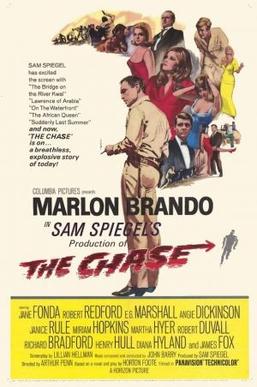
Town Without Pity-Arthur Penn’s The Chase (1966)-A Film Review   


DVD Review


By Sam Lowell


The Chase, starring Marlon Brando, Robert Redford, Jane Fonda, directed by Arthur Penn, based on the book by Horton Foote, screenplay by Lillian Hellman, 1966


Okay let’s go by the numbers here. Take a play about small town oil boom town 1950s Texas by the great Texas novelist Horton Foote (okay, okay maybe not the greatest that title would have to go Larry McMurtry in his prime with The Last Picture Show). Throw in a screenplay by Lillian Hellman who despite her inability to tell a politically truthful statement back in her Stalinist sympathizer days could write excellent screenplays-just ask Dashiell Hammett. Add in a great and thoughtful director Arthur Penn (who later expressed dissatisfaction with the results of the film). Top off with a whole crew of young up and coming actors like Robert Redford, Jane Fonda, Angie Dickerson, and Robert Duvall, who were still hungry (and a well-known one in Marlon Brando when he still had a hungry edge). Result a pretty good sleeper film from the 1960s The Chase which I am surprised I did not see back in the day but which sticks out as ensemble cast film from an age when such melodramas would be too over-played.         


Funny this film could be called The Chasers since it is much about the sordid, dysfunctional, sometimes comic life styles of the town’s residents as about the guy being chased. That guy Bubber (played by a very young Robert Redford who frankly did not, does not fit the category of Bubba when you think about that good old boy type) who escaped the state penal farm with another con who had gotten frisky with a guy they were trying to rob and killed him so the escape turned into felony murder thus creating the chasers as Bubba headed back to town after being left behind high and dry by his fellow con and after striking out on his other options.


Naturally Bubba’s movements are of great concern to the high sheriff,  Calder, played by Marlon Brando, to Bubber’s young and attractive wife, Anna, played by Jane Fonda who while he was in stir was having an affair with the son of the local magnate banker, to that son Jake who was a friend of Bubber’s from childhood, to that banker who was worried once he found out that his son was having an affair with Anna, to one of that banker’s Walter Mitty employees, played by Robert Duvall, who ratted him out when they were kids, to his distraught parents worried that the sheriff will shoot first and ask questions later, and to half the township’s population worried that Bubber will come back and seek revenge for any hurts imposed on him. Will wild out on them and their comforts mainly drinking too much booze, rousting blacks, and having a confusing set of sexual affairs for which one would need a scorecard-if one were interested.     


Although Sheriff Calder tried might and main to impose the sense of the rule of law on the angry, scared and drunk townspeople who in the end turned into just another vicious mob bent on vigilante justice that drunken mob got out hand and Bubber got a few slugs and his face down right on his hometown street. Some of this one is a little too melodramatic especially the casual sex-capades thrown around during the night’s drinking bouts but overall the film gave an interesting slice of life in the golden age of the oil boom down in oil fields Texas.

Thursday, August 25, 2016

Once Again On Making Allies Where You Can-On The Question Of The War Tax Resisters


Frank Jackman comment:


Recently I made a comment concerning this same general subject of basically individual resistance to war by refusing to pay for the war taxes demanded by the government to continue their endless wars where I mentioned that a long time ago I had given up trying to figure out the best way to combat war, the best way to make the war- makers scream “uncle” (“Uncle Sam,” better). This of course was said in frustration after I/we had tried to shame the monster back in the old days of the Vietnam War with marches, vigils, rallies in our local cities and towns, and ultimately Washington when the monster continued to prove unmovable. Tried to shut down their damn government, unsuccessfully, bitterly unsuccessfully, on May Day 1971 and got nothing but mace, tear gas and mass arrests into the bastinado for our efforts. Tried to get to the front-line fighters of their wars-the mainly working class soldiers, the cannon-fodder, the grunt who fight every war with coffeehouses and advice that it was in their hands to end the damn thing. To walk away guns in hand and say the hell with it and if that didn’t work maybe “turn the guns around” on those who were ordering the fighting from the front-line generals to the President and his cronies.


All along that way, working in the background a lot except for the requisite formal endorsement of whatever good work was worth endorsing-on paper anything- stood the War Resisters League with the seemingly simple proposition that if you, meaning you the individual, withheld your war tax money from the government that would dry up their capacity to fund war, and thus put a big crimp in their ability to wage war.


I also mentioned in that comment that sometimes though a simple proposition turns into its opposite, turns into a nightmare of bureaucratic paperwork when you come right down to the core of the matter. The dear friends at the IRS do not like, very much do not like, folks who do not pay their taxes, for good reasons or bad. Strangely go after the good reasons, the refusal to fund wars reasons almost more fervently that fraudulent tax evaders and others seem not to pay their fair share for the wars they have created, or have a vested interest in. Don’t like folks sending in letters in lieu of taxes saying exactly why they are not paying up. Get worked up so bad that they have a field day dragging you before investigators, inspectors, supervisors, boards, and such. Are gleeful when they are able to finally garnish your salary including lots of penalties and interest. So that simple strategy, one might say absolutely rational strategy, got added by one Frank Jackman to the heap of ideas that did not work out so well about stopping the war-makers in their footsteps. Oh, by the way, that has not stopped one Frank Jackman from protesting every other way he has been able to raise as much hell as he could with the war-makers.               


Wednesday, August 24, 2016


Arson, My Sweet-With Cary Grant’s Talk Of The Town In Mind (1942)-a Film Review       


DVD Review


By Sam Lowell


The Talk Of The Town, starring Cary Grant, Jean Arthur, Ronald Colman, 1942


No question the late 1930s, early 1940s was the golden age of romantic comedies, and if it was left at that this film under review directed by George Stevens one of the three best such directors along with Preston Sturgis and Frank Capra (and maybe a fourth with Howard Hawks but you can bicker among yourselves on that one), The Talk of the Town, would survive scrutiny in that category. Certainly with well-known skilled comedic actor Cary Grant at that phase of his career and Jean Arthur the wise almost girl next door with the heartland heart of gold in the lineup with her own set of comedic skills the argument could be made for throwing this one under that category.


But hear me out on this one. Agreed that the late 1930s and early 1940s were something like the golden age of romantic comedy which were necessary in the hard-bitten Great Depression times to keep people from falling off their chairs but it was also the age of social dramas, movies that took on some of the social issues that pressed against the times. Here’s the play. Leopold Dilg (played by Grant) is something of a poor man’s social philosopher who winds up on the wrong side of the stick when the local town factory goes up in flames and the foreman is allegedly killed as the place burns to the ground. The owner accused the rabble-rouser Dilg of the dirty deed and is able to make it stick, make it stick with a slander campaign that gets the town all riled up at the agitator. So they are ready, well, a jury of his peers and county men are ready to make him take the big step-off since he cannot prove that he did not do the deed.               


Being a smart guy and knowing that if “justice” prevails he is liable to be at the short end of a rope Dilg escapes the bastinado and eventually winds up at the house that Miss Nora Shelley (played by Arthur) is preparing for law school dean Lightcap (played by straight man Ronald Colman) who is looking for a little peace and quiet in order to write a nice little lawyerly book about the virtues of the rule of law. Naturally Nora cannot feed Dilg to the wolves on his trail s so there is a slew of misadventures to keep the wolves away from Leopold but also to keep stickler for the law Professor Lightcap in the dark about his presence.  


Eventually the good professor catches on about who Dilg really is and is ready to send for the gendarmes and let justice take its due course. Along the way the good professor is told that he has been nominated by the President to be on the United States Supreme Court and so he had better keep his nose clean, keep a low profile. Naturally everything militates against that as he is dragged into Dilg’s defense both by Nora’s entreaties and by the cut of Dilg’s jibe (that fellow philosopher king business). Through stealth and just plain pluck the good professor finds out that the allegedly dead foreman is not but hiding out in the wilds of Boston. The whole arson thing had been a caper by the failing owner of the factory and the foremen to grab the insurance money and run. Although it was a close thing the rule of law trumped that of mob rule (the influential had the townspeople all riled up and ready for a lynching). In between it turned out that both the fellow philosophers had eyes for wholesome heartland girl-next-door Nora but you know as well as I do that Dilg/Grant would win that battle. But do you see what I mean about his being more than a romantic comedy and more of a social drama. You decide, okay.      

Monday, August 22, 2016


When The Folk Minute Faded-With The Music Of Erick Saint-Jean In Mind.


CD Review

By Zack James

Urban Folk Blues, various artists including Erick Saint-Jean, Astra Records, 2006

It was bound to happen if one lived long enough was Seth Garth’s immediate impression after a first listening to the Urban Folk Blues album Sid Daniels, the key producer of the compilation as it was in its  pre-release stage for comment by various music critics, send him. Despite the fact that he was in semi-retirement, had not written for the natural publication to place the review The American Folk Newsletter for years and had pretty much he thought exhausted his supply of worthwhile comment on the folk minute of the 1960s since it was, well, only a minute guys like Sid, seemingly a thousand guys like Sid who remembered his work from Rock magazine and Rolling Stone and it seemed every week would bring some memory CD trying to cash in on the hard commercial fact that after a certain age people tended to want to listen to the music that brought them to the music of their generation. So everybody was trying to cash in on the big baby boomer demographic that had a fair amount of discretionary income before the extra dough as he was beginning to become too familiar with would have to go to medicines and doctors’ bills.  

That “bound to happen” moment he had after listening to Sid’s CD had been the realization that some of the songs on the CD had been covered by guys like Dave Von Ronk doing his version of Cocaine Blues and Erick Saint Jean doing his cover of Railroad Bill which they had “discovered” in their travels through the earlier American songbook they were all crazy, Seth too, to find out about in order to break out of the vanilla existence that was their growing up times when their parents’ generation wanted to bury the past. Didn’t want to go back any further that Tony Bennett, Frank Sinatra and Peggy Lee who helped them get through World War II. And now here he was being asked to review a compilation of works which were now seen as classics for his aging generation. Yeah, what goes around comes around.   

The second impression that Seth got though had more to do with who was on the compilation, and what they hell had happened to them. Everybody knew that the “king of the hill” bob Dylan had embarked on what would eventually be a never-ending tour and that prior to his death Dave Von Ronk would show up regularly on the dwindling folk circuit, the few places scattered in the universe where there were enough old folkies to sustain a coffeehouse-you know Ann Arbor, Berkeley, the Village, Harvard Square- or if away from those old-time centers then some thoughtful monthly coffeehouses at UU churches or places like that. But Seth was not thinking about the fates of those guys which was well documented but a guy like Erick Saint James who back in the day looked like he would threaten Dylan for that king of the hill title.  

Erick Saint James had it all going for him, a strong baritone, good basic guitar skills, knew a dozen chords or so, which as one wag mentioned at the time was all you needed to get a place in the folk universe, better, have all the girls hanging around you. Erick in addition was a good-looking guy who graced many covers of Rise Up Singing Folk, the original “must read” publication that got many young folkies their first look see. He had big hits with covers like Railroad Bill but also with his own compositions like Falling Light Rain and Panama Special. Then a few years later he fell off the folk map, Seth who spent many hours tracing the whereabouts of every possible folksinger in order to keep up with the movement, and grab free-lance jobs once editors like Benny Gold and Sam Lawrence knew that he had enough knowledge to write quick reviews when they were pressed for publication time-lines.   

So Seth worked his way back. Found out that Erick had had a streak of bad luck, bad management, a bum agent both things besides talent which you need to have working for, not against, you. Had a few songs, a couple of albums that went nowhere. Of course that was around the edge of the folk minute, the point where folk rock was the place to be or get off the boat. That was the fact of life. Part of Seth’s loss of Erick’s whereabouts had been that he was on the envelope of what would later be called the “acid” rock moment and so had let whatever he knew about folk kind of fall off of his planet. That was where his career was heading, where he was getting assignments and so the fate of stray folk guys like Erick faded in the background. That too was a hard fact of life just ask Benny or Sam. 

Then Erick hit some skids, got caught up doing too much alcohol and later too much grass, then heroin. As far as Seth could trace that decline into the late 1980s that was what had happened to Erick. One source said he went down to Mexico to study painting while he was trying to dry out. Another said that he was down in some Jersey Holiday Inn doing a lounge lizard act for coffee and cakes. In any case the trail ended around 1990 so who knows what happened to him. All Seth knew was that back in the day Erick could cover the old time folk songs, worked at it and added a few gems to the folk section of the American songbook. Yeah, if you want to know what it was like when guys and gals sang folk for keeps, when Erick Saint James sang folk for keeps grab Sid’s compilation. Listen to Dave, Tom, Geoff, Tracey and Jesse too but weep a tear for Erick and your lost youth too.      

Sunday, August 21, 2016

Heading Toward The Danger When It Counted In The Red Scare 1950s Night-The Saga Of The Golden Rule


Frank Jackman:

Those of us who grew in the blessedly behind us Red Scare Cold War 1950s night and who innocently suffered through the torments of ducking our heads and asses down in some forlorn school basement come air-raid drill time missed a few things. Didn’t get to know much more than if we didn’t duck those heads and asses we were doomed. Like if the “big one,” and everybody from about first grade on knew the big one meant that the Russkies, Uncle Joe and his minions, had set the trail for total destruction had really occurred some candy-ass basement was going to save us. What we didn’t know because nobody gave a rat’s ass to tell us we would have been just as well off staying right at our desks in the classroom because when and if the big one blew around Boston town we were goners anyway.

Well, enough of youthful Cold War horror stories because the really important thing that we did not know, as elementary and junior high school students did not know, was that there were people, brave people anyway you cut it who challenged the conventional wisdom, did not buy into the idea that we all had to suffer the nuclear winter the governmental flaks were warning us about if we didn’t go toe to toe with Uncle Joe and his minions and built more and more thermonuclear bombs. And test then out in what was supposed to be “no man’s land,” out in the deep Pacific. But some brave souls in places like New York and Boston demonstrated against the nuclear madness. And they were brave. But the bravest of them all, the ones we should thank profusely even today, maybe especially today as a new cold war seems to be on the agenda were those serious pacifists who outfitted the Golden Rule and headed toward, not away from, the danger of the nuclear test bomb sites to say, well, to say “stop the madness.” Yeah, stop the madness now. Check out the story of the Golden Rule and its recent restoration to once again go toward not away from the danger.   
The “Shame” Culture Of Poverty- Down In The Base Of Society Life Ain’t Pretty


By Josh Breslin


Recently in reviewing Frank McCourt’s memoir of his childhood in Ireland, “Angela’s Ashes”, I noted that McCourt’s story was my story. I went on to explain that although time, geography, family composition and other factors were different the story he tells of the impoverished circumstances of his growing up “shanty” in Limerick, Ireland, taking all proportions into consideration, was amazingly similar to those I faced growing up “shanty” in a Boston, Massachusetts suburb a generation later. The commonality? I would argue that down at the base of modern industrial society, down at that place where the working poor meets what Karl Marx called the lumpen proletariat the sheer fact of scarcity drives life very close to the bone. Poverty hurts, and hurts in more ways than are apparent to the eye. No Dorothea Lange photograph can find that place.


I also mentioned in that McCourt review that the dreams that came of age in that Limerick childhood neighborhood, such as they were, were small dreams. I immediately picked up on his references to what constituted “respectability” in that milieu- getting off the “dole” and getting a low-level governmental civil service job that after thirty some years would turn into a state pension in order to comfort oneself and one’s love ones in old age. Hell, not even a gold watch for meritorious service for God’s sake. That, my friends, is a small dream by anybody’s standard but I am sure that any reader who grew up in a working poor home in America in the last couple of generations knows from where I speak. I can hear my mother’s voice urging me on to such a course as I have just described. Escaping that fate was a near thing though. The crushing out of big dreams for the working poor may not be the final indictment of the capitalist system down at the base but it certainly will do for starters.


In the recent past one of the unintended consequences of trying to recount my roots through contacting members of my high school class has been the release of a flood of memories from those bleak days of childhood that I had placed (or thought I had) way, way on the back burner of my brain. A couple of year ago I did a series of stories, “Tales From The ‘Hood,” on some of those earlier recalled incidents. Frank McCourt’s recounting of some of the incidents of his bedraggled upbringing brought other incidents back to me. In “Angela’s Ashes” he mentioned how he had to wear the same shirt through thick and thin. As nightwear, school wear, every wear. I remember my own scanty wardrobe and recounted in one of those stories in the series, “A Coming Of Age Story”, about ripping up the bottoms of a pair of precious pants for a square dance demonstration in order to ‘impress’ a girl that I was smitten with in elementary school. I caught holy hell for that (and missed my big chance with the youthful “femme fatale” as well-oh memory).


I have related elsewhere in discussing my high school experiences in that series that I did a couple of years ago at the request of one of my high school classmates, that one of the hardships of high school was (and is) the need , recognized or not, to be “in”. One of the ways to be “in”, at least for a guy in my post-World War II generation, the “Generation of ’68,” and the first generation to have some disposable income in hand was to have cool clothes, a cool car, and a cool girlfriend. “Cool”, you get it, right? Therefore the way to be the dreaded “out” is….well, you know that answer. One way not to be cool was to wear hand-me-downs from an older brother. Or to wear oddly colored or designed clothes. This is where not having enough of life’s goods hurts. Being doled out a couple of new sets of duds a year was not enough to break my social isolation from the “cool guys”. I remember the routine-new clothes for the start of the school year and then at Easter. Cheap stuff too, from some Wal-Mart-type store of the day.


All of this may be silly, in fact is silly in the great scale of things. But those drummed-in small dreams, that non-existent access to those always scarce “cool” items, those missed opportunities by not being ‘right’ added up. All of this created a ‘world’ where crime, petty and large, seemed respectable as an alternative (a course that my own brothers followed), where the closeness of neighbors is suffocating and where the vaunted “neighborhood community” is more like something out of “the night of the long knives”. If, as Thomas Hobbes postulated in his political works, especially "Leviathan", in the 17th century, life is “nasty, short and brutish” then those factors are magnified many times over down at the base.


Contrary to Hobbes, however, the way forward is through more social solidarity, not more guards at the doors of the rich. All of this by way of saying in the 21st century we need more social solidarity not less more than ever. As I stated once in a commentary titled, “Brother, Can You Spare A Dime?,” one of the only virtues of growing up on the wrong side of the tracks among the working poor is that I am personally inured to the vicissitudes of the gyrations of the world capitalist economy. Hard times growing up were the only times. But many of my brothers and sisters are not so inured. For them I fight for the social solidarity of the future. In that future we may not be able to eliminate shame as an emotion but we can put a very big dent in the class-driven aspect of it.