Search This Blog

Sunday, March 3, 2013

Out In The Jazz Age Night- F. Scott Fitzgerald’s The Great Gatsby

FromThe Pen Of Frank Jackman

One would have to be rather pedantic not recognize that F. Scott Fitzgerald was an important novelistic voice of the Jazz Age in post World War I America. Certainly not the only voice of that age but the voice which best exemplifies the tensions between the mores of ‘old wealth’ and the emerging sources of ‘new wealth’ that were produced by the huge amount of money available, mainly through government contracts as result of the war, or riches gained through the illegal liquor trade. That is the sociological underpinning that drives Fitzgerald’s work. This is no better example of those strivings than the Great Gatsby. If nothing else it is a dramatic enactment of the strivings of the new money to ‘make it’ in the world of high society, one way or another. And what better way to do that than in the age old tradition of buying one’s way into that society through marriage. This is the modern American version of that story.

And the story itself? One Jay Gatsby, the former Jimmy Ganz, freshly reinventing himself after indeterminate service in the American military in World War I and loaded with cash from questionable financial resources, attempts to win, or rather re-win the affections of one Daisy Buchanan his vision of the perfect life companion and exemplar of the‘old money’ crowd that he wishes to crash. One little complication, however, gets in the way. She has found herself married to a brutish but wealthy member of that ‘old money’ crowd. Gatsby’s fumbling but lavish attempts to lure her away from the high society of Long Island, then the summer watering hole of the‘old money’, forms the core of the story. Gatsby’s trial and tribulations on the way as narrated by Nick Carroway (and Gatsby’s somewhat unwitting accomplice in the matter) keeps the story line going until the final deadly ending. The morale- the very rich are indeed very different from you or me. Moreover, someone else will always have to pick up the messes they have made for themselves. They merely move on. This may serve as a cautionary tale for that time and possibly today. Certainly nobody has chronicled the end of the age of American innocence signaled by the Jazz Age better than Fitzgerald.

A word on literary merits. According to the inevitable changes in literary fashion as well as literary politics Fitzgerald, for long a leading figure in the canon of American literature has been somewhat eclipsed by other more post-modernist trends. While I firmly believe that the Western canon is in dire need of expansion to include ‘third world’, woman and minority voices Fitzgerald’s literary merits stand on their own. His tightly- crafted story line, his sense of language and the flat-out fact that that he knew the subject matter that formed the basis of his expositions merit renewed consideration by today’s reader. Simply put, if you want to understand part of what was going on in America in the 1920’s before the Great Crash of 1929 then you simply have to read the man. If nothing else read the last few pages of Gatsby. If there is a better literary expression of the promise of America as seem by the early Dutch settlers of New York as the last best hope of civilization and the failure of that promise at the hands of the ‘robber barons’ and their descendents I have not read it.

Out In The Film Noir Night- Robert Penn Warren’s All The King’s Men


From The Pen Of Frank Jackman


All The King’s Men, Robert Penn Warren, twice adapted for the screen

I have seen both film versions of Robert Penn Warren’s classic tale of the rise and fall of a ‘populist’corrupted politician, Willie Stark, based at least loosely on the political career of 1930’s Louisiana Governor Huey Long. America has had no shortage of such politicians who have allegedly championed the cause of the ‘little people’in their rise to power while on the side lining their pockets and the pockets of their friends. The late Governor of Alabama, George Wallace, comes to mind as a more modern example but there have been others, some who did not bother to champion the cause of ‘little people’ or anyone else, for that matter.

The question before us, however, is who is the real Willie Stark. Since the story line is fairly simple and familiar from a glance at today’s newspapers or a look at the political landscape it is the believability of the performances in the films that counts here. Broderick Crawford played in the original black and white film version and won an Academy Award for his performance by acting as a initially naïve country bumpkin with a thirst for power to do ‘good’ who is corrupted by power as he goes about the business of governance. Seemingly, all his baser instincts come into play and there is an almost fatalistic sense that he is in for a big fall.

Sean Penn in the more recent version seems to be more world weary about the political process and cynical about what he can do for the ‘people’ and himself when in power. Of the two, Crawford just seems to be more comfortable in his interpretation of the role. Moreover, in the recent version the narrator’s story, that of a troubled alcoholic former news reporter hired by Stark as his smooth-tongued flak, takes top-billing and that diminishes Stark’s role in all the shenanigans. For my money, although Penn’s performance may appeal to today’s more politician-averse audience Crawford wins this duel. View both films and you decide.


***Those Oldies But Goodies…Out In The Be-Bop ‘50s Song Night- Billie’s Back- The Crests’ “Step By Step”


Peter Paul Markin comment:

This is the back story, the teen listener back story if you like, going back to the primordial youth time of the mid to late 1950s with its bags full of classic rock songs for the ages. Of course, any such efforts have to include the views of one Billie, William James Bradley, the schoolboy mad-hatter of the 1950s rock jailbreak out in our “the projects” neighborhood. Yah, in those days, unlike during his later fateful wrong turn trajectory days, every kid, including best friend Markin, me, lived to hear what he had to say about any song that came trumpeting over the radio, at least every one that we would recognize as our own.

Billie and I spent many, many hours mainly up in his tiny bedroom, his rock heaven bedroom, walls plastered with posters of Elvis, Bo Diddley, Chuck Berry, somewhat later Jerry Lee Lewis, and of every new teen heartthrob singer around, heartthrob to the girls that is. And on his night table every new record Billie could get his hands on, by hook or by crook, and neatly folded piles of clothing, also gathered by that same hook or by crook, appropriate to the king hell king of the schoolboy rock scene, the elementary school rock scene between about 1956 to 1960. Much of that time was spent discussing the “meaning” of various songs, especially their sexual implications, ah, their mystery of finding-out-about-girls worthiness.

Although in early 1959 my family had started the process of moving out of the projects, and, more importantly, I had begun to move away from Billie’s orbit, his new found orbit as king hell gangster wannabe, I still would wander back there until mid-1960 just to hear his take on whatever music was interesting him at the time. These commentaries, these Billie commentaries, are my recollections of his and my conversations on the song lyrics in this series. But I am not relying on memory alone. During this period we would use my father’s tape recorder, by today’s standard his big old reel to reel monstrosity of a tape recorder, to record Billie’s covers of the then current hit songs (for those who have not read previously of Billie’s“heroics” he was a pretty good budding rock singer at the time) and our conversations of those song meanings that we fretted about for hours. I have, painstakingly, had those reels transcribed so that many of these commentaries will be the actual words spoken during those conversations (somewhat edited, of course). That said, Billie, king hell rock and roll king of the old neighborhood, knew how to call a lyric, and make us laugh to boot. Wherever you are Billie I’m still pulling for you. Got it.
********
Billie, William James Bradley, comment:

What the hell’s going on? It is almost like I can’t even listen to my transistor radio these days without wanting to throw up. Yes, that’s right throw up. And Markin, Peter Paul Markin, my best friend over at Adamsville South Elementary a couple of years back will back me up on this if he even comes back around the old neighborhood to breathe some real air, some fresh sea air, and get the low-down on what is good in music these days. Except I won’t have much to tell him right now. Like I said I feel like throwing up most of the time when I listen to the radio. Nothing righteous. Nothing like Elvis when he was righteous, hungry and righteous, a few years back. Or Jerry Lee before he got into cousin-marrying trouble or Chuck Berry when he got into no-no white girl trouble. Fabian, Conway Twitty, Duane Eddy, Ricky Nelson, jesus, even Ricky Nelson, the Everly Brothers and on and on with twaddle, yes, twaddle about this and that oddball thing about teen life. And girls, girls with money to buy the records, who seem to just want dreamy stuff about sad movies, some sad-sack boyfriends, johnny, jimmy, joey angels, following guys to the end of the earth, and all that. No more be-bop-a-loola. I tell you we are in the dumps and it ain’t getting better, if anything worst.

Here is what I am up to these days, and maybe you should be too. I am starting to listen and listen hard to doo wop stuff. The stuff that came out of the street corners of New York City and other big town places where you had guys (and chicks too) singing, no instruments, or maybe some low-down, low-key piano, just doing harmonies, and doo wop background responses. Cool. Yah, I know I got in trouble, musically anyway, trying to cover righteous Bo Diddley down here in the white projects playing off“colored” music that really, really I say, drove early rock. Just ask Elvis, if he is in a truthful mood.

But this stuff, this doo wop stuff, if it gets around more, can break the pretty boys and their dreamy girl thing up. So here is what I am doing now that it is summer, school is out, it’s hot, and we haven’t got a damn thing to do, and no money to do it with if we had that damn thing to do. I have been listening to doo wop records like crazy, right now I am concentrating on the Crests and their great harmonies on Step by Step. Here is what I want to do just like we tried last summer when Markin was around more. A few guys, a few of my guys, my hanging-around-waiting-to-do-this-and-that-but-just-now-waiting-fire-guys, will get together around dusk in back of the old school around the playground area and start practicing harmonies. Markin scoffed at the idea at the time, as usual. But then, just as the sun started going down, a couple of girls would come by to listen and not “dogs” either, or sticks. Then a couple more, and a couple more, and there you have it.

Of course after that Markin wanted to do it every day, all day, even in the afternoon heat, and Markin hates the heat. So I figure that we can try it again this year and maybe we can break out of the Bobby Vee mold. But see here is where I am on the hook. If you can believe this I need Markin, need him bad. Last summer when he was around more I tried to keep him in the background as his voice was starting to change. Yah, I tried to ship him and his voice to Chicago if you want to know the truth, best friend and all. But lately I have been having trouble on the call and response side ofStep by Step and now that Markin has a more bassy voice I sure could use him otherwise I will never break out into my proper place in the doo wop world. Got it, Markin.

The Crests

Step By Step lyrics


Step, step. Step, step. Step, step... Step, step

Step by step I fell in love with you

And step by step it wasn't hard to do

Kiss by kiss and hand in hand

That's the way it all began

Soon we found the perfect plan for love

Side by side we took a lovers walk

Word by word we had a lover's talk

One word led to another and then

Then in no time we're up to ten

My heart knew it was gonna end in love

1st step, a sweet hello

2nd step, my heart's aglow

3rd step, we had a date

4th step, we stayed up late

5th step, I walk you home

6th step, we're all alone

7th step, we took a chance

One kiss and true romance

Step by step we climbed to heaven's door

Step by step, each thrill invited more

Then you promised faithfully

All your love belonged to me

Now I know we'll always be in love

Step, step. Step, step. Step, step. Step step

Out In The English Revolution Night-The “Crowd” In Restoration England-London Crowds In The Reign Of Charles II


Book Review

London Crowds In The Reign Of Charles II: Propaganda and politics from the Restoration until the exclusion crisis, Tim Harris, Cambridge University Press, 1987
One of the virtues of historical studies over the past several decades has been the full-fledged efforts by various groups of historians to bring “the people,” those below the level of great actors, their entourages, and those who control the throttles of power to get their day in the sun. The tension between that view, and the previously dominant prevailing view that looking from the top down was the only justified way to see things in history, earlier history anyway, continues to this day and will probably always continue. Even in my own mind after reading some of the accounts of more plebeian actions on other subjects I am not sure that the voices from below as they affected policy are not sometimes overblown. That does not appear to be the case here with Professor Harris’s analysis of the crowd in his The London Crowd In The Reign Of Charles II which highlights various plebeian-inspired political actions in that town during the restoration of the monarchy via the ascension of Charles II shortly after the death of Oliver Cromwell in 1660.

Of coursewhen one speaks of revolutionary periods, at least modern revolutionary periods, and the English Revolution of the 1640-1660 counts in many ways as the first modern European revolution, the crowd, small merchants, town workers, artisans, masters, and as here in this period apprentices, are almost automatically have a role in the agitation, for good or evil. Professor Harris has taken the lead from such renowned “crowd-followers” as Professor Georges Rude and Professor Thompson and their studies of later periods to put some light on the role of the crowd, what motivated those crowds under certain circumstances, and more importantly to the Professor whose political lead were they responding to, or being manipulated by. No question the period of the 1640s the London crowds were in motion from Levelers to army agitators too every known religious sect, mostly Protestant-derived, that had something to say. And also no question that the period from 1659-60 also had the crowd in motion will some of the same actors who had previously defended the commonwealth now crying for restoration. Those of us who have tracked revolutions are familiar with such ebbs and flows.

What makes Professor Harris’ study of interest is that during the restoration itself the crowd shifted several different ways and not always, as one would have presumed, toward what he called the Whiggish direction, the liberal direction. In short the crowd could respond (and be organized by) the Tory element favorable to the crown. (Whig and Tory are in this period convenient terms of art for what would become more concrete organizational and governmental tendencies later.) Of course the subject that drove most of the action (although not all of it as the economic downturn protests and other events of that nature testify to) was Charles II’s toleration, or non-toleration, of religious dissenters, especially Catholics. And in the 1680s closer to home the various exclusion crises over what to do about the avowedly Catholic James II (his brother) the presumptive heir to the throne upon his death. So during this period we have a plethora of anti-Pope bonfires, anti-dissenter marches and parades, and anti- James II actions as well as actions by the other side on these issues to test his thesis. Needless to say with a Cambridge University Press imprimatur there are many footnotes and a solid bibliography here to be used by those who want to pursue this subject further.


Saturday, March 2, 2013

Poet’s Corner- Claude McKay-If We Must Die-In Honor Of The 94thAnniversary Of The Communist International


…they had heard that a group of White Guards, a first detachment on horse, maybe from the dreaded mercenary Czech Legion that were running amok from Siberia to the Urals, paid for by who knows, some said the English some said the French, or worst maybe the dreaded Cossacks, who needed no outside pay but only their Ataman’s word to bend contemptible peasant heads to size, and who took no prisoners, none, were heading their way, heading right for their line of defense in the city ready to take back Kazan for the asking, so those Whites thought. Kazan fallen then the road to Moscow lay wide open and perhaps the end of the Soviet experiment in that dragged on second year of hellish civil war. But Commissar Vladimir ( assigned that title because he, a little more literate, a little cooler under pressure, than the vast bulk of lumpish peasants who had signed up to fight and to die for the land, their land from what they had heard, was listened to by that mass unlike the city boy reds) and his band of comrade brothers, five in all, (and one sister, one stray Red Emma, they called her who learned of revolution and sex, young love smitten sex even in war-torn Kazan with young Zanoff, in that exact order while in their company and proved as fierce a fighter both ways, according to that same Zanoff, as any man), the last remnant from the old Orlov estate who survived the bloody endless Czar war swore, swore a blood oath on their tattered red flag, the previous day that they would retreat no further, that here was their stand, their last stand if necessary, but no more moves away from Moscow.

It had not always been that way with them, not even with Vladimir, not by a long shot. They had all farmed, like their fathers going back eons before them, the same fruitless task (for them) land for Orlov, the richest landowner in Omsk, and never lifted their heads when the Social Revolutionaries had come before the war and during that last revolution, the one back in 1905, with glad tidings (and before them other city radicals, narodniks or something like that, had spoken to their fathers and grandfathers). They just shoveled the dirt, kept shoveling, and kept their heads down.

Then the war came, the bloody world war as it turned out, and the Czar’s police (Orlov’s really but in the name of the Czar so the same thing) came and “drafted” them into some vast ill-fed, ill-clad, ill-armed peasant force which proved no match for the methodical Germans as they were slaughtered by the millions in and around those foul trenches. And still they kept their heads bent. Kept them bent until the February revolution stirred things up although they held to the front since no one told them not to leave and in the fall of 1917 they had just followed their fellows out of the trenches and went home. Not the first ones out, nor the last but just out. Went home to farm Orlov’s land again they figured with bent heads again. Even when the Bolsheviks took power in November and decreed the land of Orlov’s theirs they kept their heads bent. It was not until Orlov, his agents and his White Guard friends came back and took the land, their now precious land, theirs, that they roared back. And joined one of Trotsky’s red brigades passing through on a recruiting drive. They had moved here and there as the lines of battle shifted but mainly back, mainly retreats or break-ups since then and hence the blood oath, and no more retreats. The peasant slows in them had been busted, busted good.

Just then a messenger came to their line, a messenger from the river in front of Kazan. The message said that Trotsky himself had decided to fight and die before Kazan if necessary to save the revolution, to save their precious land. Vladimir and his comrades, including Red Emma, Red Emma who if the truth be told despite her tender years of sweet sixteen was the best soldier of the lot, and should have been the commissar except those lumpish peasants would not have listened to her, reaffirmed their blood oath. If they must die they would die in defense of Kazan, and maybe just maybe somebody would hear of their story, the story of five peasant boys and a pretty red-hearted city girl as brave as they, and lift their heads and roar back too….

If We Must Die

If we must die, let it not be like hogs
Hunted and penned in an inglorious spot,
While round us bark the mad and hungry dogs,
Making their mock at our accursèd lot.
If we must die, O let us nobly die,
So that our precious blood may not be shed
In vain; then even the monsters we defy
Shall be constrained to honor us though dead!
O kinsmen! we must meet the common foe!
Though far outnumbered let us show us brave,
And for their thousand blows deal one death-blow!
What though before us lies the open grave?
Like men we'll face the murderous, cowardly pack,
Pressed to the wall, dying, but fighting back!


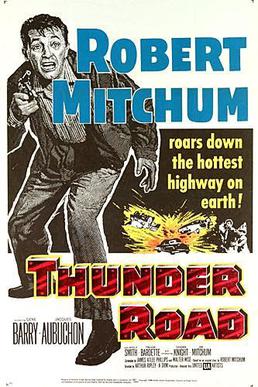
Out In The Film Noir Night-Out In The Hills And Hollows-Robert Mitchum’s Thunder Road

DVD Review

Thunder Road, Robert Mitchum, Keely Smith, Gene Barry, United Artists, 1958
…he came out of the hills and hollows (I know, I know, hollas but let’s leave it at and get to the good stuff and not get stuck on that cultural gradient business), came out in any fast-back 1950s sedan (Fords and Chevys favorites, all tooled up, all geared up to rip out the best the cops, the fed cops, the whiskey tax boys, could run against him and any other civilian hound-doggers who wanted to try, and they did and got more, much more than they bargained for) converted to dark night whiskey runs that he could put together and hold together on those back woods thunder roads. Proud of it or not proud of it, that is what he, Luke Doolin, did, ran whiskey, corn whiskey, white lightening, and if anybody didn’t like it, well, they could eat his dust, and they usually did. Ran it all around the Appalachian valleys just like his daddy and his daddy before him going back to mist of America times, pioneer times when people tired out of eastern seaboard clutter and picked up and moved west, eternally moved west, except his people lost the wanderlust early and stayed put on the worked out land, and then got wise to the name of the game.

Yes, Luke Doolin was a piece of work, something out of the olden times, old world times, old Irish times, when a man counted himself a man because he was a man and acted the part, maybe not a hero, no, definitely not a hero, but not a man to be pushed around, not with that couple of centuries pedigree out in those stark mountains, mountains where he fit in or didn’t fit in depending on his mood but where he was doomed to end his days, whenever and however that fate was dealt.

And of course Luke had that jut-jawed look, that take a punch and still stand look, that primitive man look but with some sensitive feelings, feelings that he learned to express a little when he was in the “real world,” the cities and the war fight that rounded out his education that drew women to him like a magnet. Made those women toss and turn all night, some nights anyway, thinking, thinking hard about what exactly they were going to have to do, what seductions they were going to have to perform to draw Luke’s attentions. Needless to say, mountain man that he was, only one woman, one hard-headed woman, would win the brass ring but others would surely try, try or of have more restless mountain wind nights.

Women were the least of it though, although he had had his share, maybe more that the share due him in his line of work. Trouble was brewing, always trouble when cheap jack liquor and dough combined, and maybe throw in some tough-nosed federals looking to bust the untaxed trade. See some guy, some city guy usually, because mountain people usually didn’t run to big adventure ideas-just brew the corn-run it to the cities – collect the dough and make some more, easy and done- yes, some city guy wanted corner the market, run the whole show himself. Even the thought of the idea should have sent that city guy packing, packing the first time he proposed to Luke and to the other backyard distillers the deal he had for them, the deal, or else. But once a guy gets that corner the market lust in his blood he begins to make odd-ball decisions and so there you have it. In the end it was Luke’s way too, or no way.

And as fate would have it, a fate Luke had signaled one night to one of his lady friends- “he was born of the hills and hollows just like other men were born of the sea, it was in his blood, no, more it was a way of thinking about things, about how you wanted to be treated, about what you would, or would not, take, maybe, not like other men who would give a little here, give a little there and then before you knew it they were hollow men, men working for some clock, or something like that. All he knew was that at night, in the middle of the night, with the moon blasting away, the driver window down, maybe on the passenger side too, a cigarette hanging from his sullen lip, taking the turns all sweet and gentle one minute all tense and taut the next he felt alive, felt part of something, felt like the mountain wind’s own brother.” Let leave it at this, he said , it was hard to explain, hard to explain to a woman, a woman with her home-seeking ways, but if that didn’t explain it then just this- “he was a transporter, and that was what he did, and so he would play his hand that way –there was no other way out.”

Hell, they still talk about old Luke and how he got it, got it just like he lived it that night he ran that last run out of the hills and hollows of thunder road and how he did it his way, his way alone, and about how they didn’t make them like Luke any more…

And hence this film


Friday, March 1, 2013

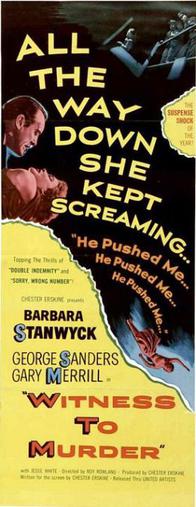
Out In The Film Noir Night- Barbara Stanwyck’s Witness To Murder

DVD Review

Witness to Murder, Barbara Stanwyck, Gary Merrill, George Sanders, United Artists, 1954
The last time the name Barbara Stanwyck appeared in this space she and Fred MacMurry were plotting, plotting big time, to murder her husband for his life insurance policy (and other considerations left unsaid ) in the film adaptation of James M. Cain’s Double Indemnity. Times have changed for Ms. Stanwyck though as here in Witness To Murder she off-handedly witnesses what she believes is a murder of a woman by a man in the apartment building across from her one night. And, unlike in Double Indemnity where everybody and their brother (and sister) KNOWS she and Fred did the deed here she cannot get anyone to believe her. Especially when the mad man who actually did the deed was a Svengali –like mastermind, an alleged ex-Nazi (although that de-nazification program stuff after World War II didn’t seem to take in his case), played by George Sanders.

Now the problem with accusing someone of murder, murder most foul , who actually did the deed is that unless and you have a body you are in trouble trying to pin the rap on him. Moreover, yelling bloody murder about the guy is going to, well, put him off-balance especially when he is lined up to marry into some serious California dough. So you might as well say Ms. Stanwyck’s life just got very complicated, very complicated in deed when she takes a small stand for some rough justice in this wicked old world. Worst this murderer is so smooth that the cops, the guys who are supposed to live to solve dastardly crimes are practically taking up a collection for the poor guy and are ready putting her in the loony bin, for good. Really. Of course one cop, the love interest cop played by Gary Merrill is not going to let a smart, sassy, good-looking woman go under without a fight. So you know in the end that this case will get solved and old Mr. Smoothie will get his just desserts. But doesn’t Ms. Stanwyck have a case for dereliction of duty or something against those nay-saying cops.