Search This Blog

Sunday, November 22, 2015

A Raven With A Broken Wing- With Veronica Lake and Alan Ladd’s This Gun For Hire In Mind  


From The Pen Of Sam Lowell

“Everybody, every corner boy knew that the Raven, that’s what everybody called him in the old days and most people around didn’t know his first name was Phillip, would be famous someday, would put the old neighborhood in the daily headlines, put his home turf the Annandale projects in Pittsburgh on the map. And there he is now right there front and center of the F.B.I.’s 10 Most Wanted List after that caper at the Livermore Labs out on the West Coast, I am not sure exactly where but out around Frisco somewhere,” Frankie Ryan, the current Annandale Central High schoolboy king of the corner boy night was telling Bill Bradley about Annandale’s now most famous resident.

Bill had just moved into the projects, you know public housing that every town was supposed to provide after World War II for the down and out and which everybody from Mayfair swells to sociologists who study such things to the residents themselves calls the projects, a few months before when his father had run out with some woman, some whore he had been shacking up with for a while before hand when he said he was working late according to his mother when he asked where his father had gone, and  left her high and dry. So there they were reduced to public housing but what are you going to do since you had to live somewhere and it was better than the county farm where you basically stayed in a dormitory and had to do farm chores for the length of your stay which was the next step down, way down on the social curve. So Bill didn’t know about the effect that the Raven had on the kids in the projects like Frankie and his corner boys who hung on his every caper when they heard about them. Cheering him on, living vicariously through him although no one of them would have expressed it that way in a million years. Maybe didn’t know what the word vicariously meant although Frankie was covering up his native smarts behind a sullen no nothing facade (he would later turn out to be a crackerjack lawyer with a big firm in Boston when he settled scores with his wild oats and sullen looks). They were just hungry, how did Frankie put it, oh yeah, had their “wanting habits on”, for one of their own to break out anyway he could.      

In answer to Bill’s question about the Raven’s reputation around the projects this is what Frankie had to say, “Of course the Raven was seven or eight years older than the rest of us but that didn’t mean we didn’t still look up to him, especially after what he did to Father Benoit. See the Raven was living with his aunt, Fedora I think her name was, after his father who was some kind of hit man, maybe a heavy I don’t remember, for Dutch Malone’s gang out in the Midwest somewhere got caught for wasting some rum brave cop who thought the quarter million dollar heist of the First National Bank in Chicago belonged to him or something and took the big step-off, got the chair, as guys like his father do when they get caught and his mother died of a broken heart or something and so the Raven maybe about eight or nine himself then came to live with his aunt here. He husband had died and since he was some kind of city employees she got to stay here rather than the county farm when he passed on. This aunt was merciless with him, punished him for every little infraction, you know stealing candy from the jar, grabbing dough from her pocketbook, strong-arming kids at school for their milk money harmless stuff really and stuff every kid in the projects had done ever since they caught onto the projects idea to keep people off the streets and off the county farm.”

“Her idea of making a kid toe the line, make him see the light of reason according to my mother after Fedora died was to beat the badness out of the Raven. One day she went over the top after he took some candy or something, remember this is stuff my mother told me so there might be more to the story than she let on she was always “protecting” us that way not knowing we were wired into lots of stuff they didn’t have a clue we knew about, and took a hot flat-iron and broke his wrist, mangled it all to hell. That’s why they throw that photograph of his mangled wrist in the newspapers every day because it is pretty hard not to see that it was seriously deformed and easy to identify him by. Somehow that was the blow that blew the Raven’s gasket, made him stone-cold indifferent to any pain he might inflict, made him like some robot although he would always wave back to us when we waved to him at Carter’s Variety Store where we hung out. But he never smiled or if he did it meant no good.”       

Frankie stopped for a minute in his explanation to try to remember if the Father Benoit incident was two years before the Raven’s aunt’s death or more. He continued, “Yeah it had been two year before when the Raven was maybe sixteen. Part of the deal with the Raven living with his aunt meant that he had to regularly attend Mass over at Saint Francis’s on Taffrail Road, the one I go to still to. Had to attend Christian Doctrine class too. In one of the classes Father Benoit was grilling the Raven about something and the Raven gave a silly answer or surly one I forget since I wasn’t there although my older brother Johnny  whose in the Navy now getting every girl in every port the way he tells the tale was there. Now this Father Benoit didn’t take any guff and so had a reputation for not sparing the rod, the ruler is what I think he used. He ordered the Raven to the front of the class and prepared to exact punishment. Raven went up to him, gave him a stone-cold look according to Johnny, and said in a calm voice that if Father Benoit tried to impose punishment it would be his last time. They stared at each other for a moment and then Father Benoit backed off. That was the last time the Raven was seen in any church as far as I know except for maybe using one as a hideout. As for Father Benoit he would on Sunday, on any occasion as he got older declare that the Raven was the “angel of death” come to earth. But after that Raven incident the good Father never used that ruler for punishment again. So yeah even we younger boys admired the Raven.”         

Bill sat there in silent awe for a moment, Frankie too reflecting on what it took to be stone-cold tough in the world, to be indifferent to what society though about the low-lifes who lived in the projects, if they thought about them at all except when they crashed out, broke from the mold or made the Top Ten list and they started sweating that the guy was going to come up their front door.

Then Bill asked a question about when the Raven left the projects. Frankie replied, “You know after that Father Benoit thing the Raven must have realized that he could do anything, get anything he wanted if he made a man of God back down without a fight. That is when we first heard about his robbery sprees. One night, a Friday night the Raven walked into Carter’s Variety like he always did and then came out waving to us after we had waved to him. A few minutes later Mister Carter came out all pale and shaken. The Raven had robbed Mister Carter of all his cash without doing anything but telling him to give him the dough or lose his life. He gave the dough. When we asked if he was going to call the police he said he would later but he never did. And the next Friday the Raven walked into the store just as calm as could be, returned our waves like every other time, and came out with his pack of Camels that he just bought, we know he paid because Mr. Carter told us later, tapped the pack on his hand like all the guys did before they unwrapped the cellophane, open the pack, pulled out a coffin-clutcher, lit up and walked up the street to catch a bus to downtown. Beautiful. There were a few more like that gas stations, department stores and nobody called the cops until some goof in a jewelry store over in Harding got rum brave and called them in. That was the straw that broke the camel’s back.”

Bill asked why that event broke the camel’s back although he was not sure what that meant more intrigued than ever by these tales which seemed unbelievable but which he would later find were confirmed by the newspapers when they dug into the background details of the case when the Raven drew the F.B.I’s  big 10. “When the Raven was arrested over in Harding his aunt had to go draw his bail since he was still (barely) under eighteen. When she got him home not knowing what a cool customer she had turned him into she tried to use that flat-iron to break his other wrist probably thinking foolishly that he wouldn’t be able to do more crime. She was wrong. Dead wrong because unlike when he was eight and had to take it he was ten times stronger now and twenty-times angrier. He grabbed the flat-iron and bludgeoned her to death. With a nice touch he broke her wrist as well although according to my mother the coroner said that those wounds were post-mortem. That was the last anybody ever saw the Raven around the projects although we would occasionally scan the papers looking for any news about him. Nothing doing until after about four years we got this latest headline about the Raven’s latest caper which announced to us that he had been doing okay.”           

What Frankie did not know and what the newspaper headlines only alluded to was that the Raven had become a “hit man,” a freelance hit man doing whatever anybody needed to have done, done quickly and done on the quiet. After that botched unarmed jewelry heist in Harding and after the damn bludgeon murder of his aunt the Raven decided that going around without serious  weapons, and plenty of them, going around like some caveman with a club was a sure way to be dead or in prison. So he got very familiar with guns, practiced constantly to perfect his skills, did a few smaller jobs for cheap money to get a reputation for doing his work quickly and quietly. Eventually when a Mister Big wanted a rival wasted or some big time political or business guy wanted his wife, or his wife’s lover wasted they called for the Raven. Paid very nicely for quick and quiet work and the Raven prospered.                 

But the “gun for hire” business like any other business is filled with odd-ball quirks, filled with weirdoes looking to get off-the-wall jobs done. And like any other profession you have to pretty much take what comes in the door because you do not know when another job may come your way, maybe too the weirdos knows guys who need jobs done who are not weirdoes, or maybe you are bored and are willing to try an odd-ball job just to prove you can do odd-ball jobs quickly and quietly. Whatever the reason this latest caper is what got the Raven in the news and got him dug up for half the crimes committed in the country the previous four years.  

Here’s the way Frankie told it to Bill, Lenny, Larry and a couple of his other corner boys one night in front Carter’s Variety Store, half expecting the Raven to pop up in front of them with that old wave, when they asked about what the Raven was suspected of doing. “I don’t know about the other stuff, the string of gangland murders, the murders for insurance, the jealous husband or wife murders, it seems the newspapers, or the coppers, or the newspapers and the coppers, are trying to blow smoke and clean up their unsolved cases by laying them all on the Raven but this latest one, the one that has made him A Number One in my book makes sense.”      

“You know ever since the Russians got the bomb and old Stalin has the world sucking wind about it everybody in America has been going crazy to make sure that the Reds don’t get the plans for the really big next one that everybody knows we need if we are going to beat the damn commies. So some guy, a gofer, a suck-up, a pretty boy, probably a fag from his picture, who was something in Hollywood or owed somebody a favor, now dead, dead by the Raven’s hand, contacted him through this dame, some good-looking dame according to her photograph who I swear looks like Veronica Lake or one of those blonde Hollywood actresses that keep your temperature rising, who worked in one of his nightclubs as a singer. The guy, a guy named Walker according to the papers, didn’t want to go straight to the Raven because he was basically the middleman and because he was a punk really and just acting for a Mister Big. Not a gangster Mister Big but a guy who had plenty of dough, a guy who owned factories and stuff, but wanted some pull power in the world and had contacts with guys who worked at Livermore Labs where they deal with plenty of plans to make the next biggest bomb or whatever you want the next biggest and baddest of and they can figure out how to do it to order.”

“So this fluff goes to the Raven with Walker’s proposition about getting some plans from a guy who worked in Livermore, plans that would give that big factory owner plenty of power since his plants could produce whatever needed to be produced and he could give a damn about America. The Raven blew her off at first, whether she looked like Veronica Lake or not the Raven was always funny about women maybe after that aunt business although he was a pretty good looking guy in the Alan Ladd mold, a guy the girls would give a tumble if he just looked their way, some girls are like that, but he never did, tells her he only does certain kinds of jobs and this one looked like it would have the whole government down his back.”

“Now like I said I don’t ever remember the Raven ever having a girl on his arm, like I said maybe that business with his aunt turned him off women or something, made him a queer, but this blonde fluff worked on him, worked on him enough so that he bought into the idea of doing the job. But the whole set-up should have sent signals to the Raven that this caper was doomed. He must have gotten too much of that fluff’s perfume in his nose or spent too much time under the silky sheets with her.”
The Raven got to the Livermore guy alright, got through some back doors and cellars to get to his lab, had him with his hands in the air ready to give the plans, his wife and kids too if the Raven had asked, under duress but then this scientist, this nobody nothing goof scientist got rum brave himself or started seeing stars and stripes when he realized what the Raven wanted and refused. Blam, blam. The scientist got the wrong time to get brave against the wrong guy and he got himself killed for his efforts. The Raven fled trying to find the fluff to eliminate her from being able to talk about the whole deal but instead found this Walker down at one of his nightclubs, The Dove Club, auditioning acts. The Raven asked at the door if Walker was in, the usher pointed him out and he called him aside a little and without blinking his eyes, I don’t if that part is true but two of the witnesses said that is the way it went down, and put two square through his heart. Done. Now the Raven is wanted, wanted bad as some kind of red agent, a guy working for Uncle Joe according to my mother who really believes that a stone-cold killer like the Raven is working for the international Communist conspiracy something. Jesus are they kidding. I tell you thought I figure his next stop is that fluff and no silky sheets this time. I wonder how he will do the job when he catches up to that fluff, probably just like Walker. I hope he doesn’t go soft or anything like that. Hope he makes the old projects proud of him.”      
Never Trust A Cop As Far As You Could Throw One-With Otto Preminger’s Where The Sidewalk Ends In Mind


From The Pen Of Sam Lowell


“You know my grandfather told me when I was just a kid, maybe twelve or thirteen years old when you start to think about getting in trouble one way or another and when things that are said by older people still stick, never to trust a cop. They are not our friends no matter about all that stuff about protecting us and helping little old ladies across the street, they work the other side of the street and will cut you down just as soon as look at you. And Grandpa Eaton was a guy who knew the story from both sides, knew it as an official of the boilermakers’ union when they went on strike more than once down at the Fore River shipyards looking for more money and better conditions and the company let the “bulls,” that what they called them back them, run rampart on the picket lines. Bad blood all the way around, not forgotten blood not by Grandpa and his buddies which was in any case partially revenged one night when they has a copper yelling “uncle” although Grandpa wouldn’t get more specific since you never know when the statute of limitations runs out on something like that, with cops anyway.

Knew about cops as well, up close and personal since his drunken sot of a father, who died a few years before I was born so I never knew him, just off the boat from Ireland but because he had been connected someway, at least he told everybody he was,  to the Fenian Brotherhood had gotten himself on the force, had been a beat cop, which didn’t keep him from beating his wife, my great- grandmother and his kids, including my grandfather, when he was in a drunken frenzy and when they complained to the coppers the guys at the station said they didn’t handle domestic disputes. That settled it for Grandpa. A couple of Grandpa’s brothers too, learning nothing from their father’s brutal ways when they in their turn hit their women and kids when they were in a drunken frenzy. And the ghost of his father’s cronies were at play too since when those women complained at the station they got the same stonewall. Probably would today too, no, make that would today too. Later, after he told me this wisdom about cops, a couple of my uncles, his sons, wound up on the Carver force and he would barely speak with them since he had given the same wisdom to them that he gave to me and my brothers.”

“Yeah, Grandpa Eaton had it down pat, said that other than grabbing coffee and crullers those guys were worthless to do anything good, would cut you as soon as look at you,” harangued, there was no other word for it, Sam Lowell to his old friend from Troy, New York met long ago on the political protest trail Ralph Morris.

Ralph nodded his head not so much in agreement with Sam’s sentiments with which indeed he was in solidarity with having had his own fair share of run-ins with the coppers every time he and his anti-war veteran protestor buddies out in Troy or in Albany got uppity and challenged the government’s authority to wage war in their names as he was in agreement at the part about the coffee and crullers. He could just picture the “beat” cops all huddled on the stools at Jimmy Miller’s Donut Shoppe on Ferry Street, the one donut shop in Troy that he knew about from visits to Ralph there oblivious to anything going on outside the steam fogged windows. Could have been murder and mayhem but there they would be sipping coffee regulars and honey-dipped donuts.

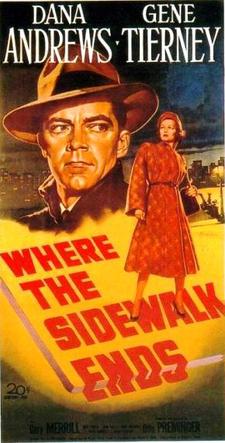
Strangely the reason for Sam’s harangue had not been as a result of being recently personally bullied by some flatfoot or being shaken down in his printing business by some cop looking for more than coffee and crullers but having just watched a film, a black and white film from the 1940s starring Dana Andrews and the fetching Gene Tierney, Where The Sidewalk Ends, where said Andrews, something of a front line matinee idol around that time, played a cop, a cop turned rogue cop, or maybe Sam said he should say he had been all along.      

Over the past several years Sam had via the beauties of Netflix been ordering all the old film noir-type black and white DVDs that he could get his hands on even those that he had seen back in the day at the old Strand Theater on River Street in Carver where he would while away a Saturday afternoon watching double feature re-run classic features and munching on popcorn like the film he was talking about before he would go to that matinee with some teen girl he was steamed up about and spent time in the balcony not watching the movie. Most of the time he would just watch the DVD and then move on but the theme of this film got under his skin and when Ralph came to Boston for one of his periodic trips to gab about old times with Sam and a few other guys from the old anti-war political days, days when they had more of cops than they could shake a stick at on their asses for one thing or another mainly just blocking stuff, buildings, traffic, sidewalks, so he decided he would tell him the plot, and ask what Ralph thought about what he had to say about it. See if Ralph still agreed after all these years filled mostly without too much strife about a cop being a bastard and best handled with no respect, or like a snake, very carefully.     

In the film plainclothes detective Steve Blair (Andrews’ part) started out from frame number one roughing up guys, bad guys from what he said to the police commander when he has to go on the carpet for his rough behavior. Of course dressing down an underling about this rough behavior business is just the higher-ups responding to the local crime padrones’ complaints about Blair since they had paid said higher-ups very handsomely not to be roughed up by some gung-ho cop who had his own graft going. See Blair was working off an old-time grudge. Blair’s father was nothing but a three-time loser who wound up taking the big step-off for some rinky-dink murder which he had committed when he was in the gangs the shame of which sent his mother to an early grave and made Blair a hard-assed copper and nothing but a scourge against hard-boiled criminals. Here is the funny duel standard though Blair had no problem shaking down every businessman in town and every independent drug dealer and second-story artist as well for his graft. So Blair was put on notice-no rough stuff or he would wind up on cheap street just another beat cop hustling for coffee and cakes and nickel and dime graft hassling highs school kids and drunsk.         

Cops make enemies though like the rest of us, although maybe rougher and tougher, and Blair’s enemigo numbero uno was Silky Tommy, the kingpin craps guys in all of New Jack City who was so well-connected both with the guys who talked funny through their noses and with the brass downtown that he was not going to take any fall guy play from Blair. Not even take any gaff for the night when Joe Bates, yeah that Joe Bates who got a fistful of medals in the war that everybody had heard about in Jack Gannon’s by-line for the Times, World War II to keep the wars straight, steered this Texas oil guy with plenty of dough into one of Silky’s hotel room crap shoots using his wife Laura (played by fetching Gene Tierney or did I already say the fetching part, no, I see I didn’t so fetching), Christ his wife like some kind of high class whore, as the hook, as catnip.

See since the war Joe had been on a downward spiral first with Father Whiskey and then with cousin cocaine and so to keep his nose good and clogged Joe worked for Silky whenever he needed to “get well. Dragging Laura down with him. Nobody ever heard that he had her turning tricks but you never know with a junkie, they are hard on their women war heroes or not. Problem was that the night in question the Texas oil man was hot with the dice, took Silky for fifty thousand and then wanted to walk away before the house percentages took him down that night. Bad idea though, always a bad idea, for anybody to walk out on Silky Tommy with that much of his dough so one of Tommy’s heavies, Eddie the Knife, bonked the poor oilman. Bonked him too hard and he passed on to wherever Texas oilmen pass. Silky Tommy called the coppers, claimed it was an accident and that Joe was the guy who brought him up and it was Joe who put the bonk on him. An easy pick-up and off to the slammer for Joe to go cold turkey or whatever was going to happen to him without his nose candy. Trouble for Tommy, trouble for Joe too was that the detective on duty that night was Steve Blair. Blair said he smelled a rat and when Tommy said he didn’t give a rat’s ass what Blair thought Blair roughed him up, roughed him up good. Of course he would be before the Precinct Captain in the morning bright and early but worse than roughing up Silky was that Blair bought the story, bought the Joe did have some part in doing the deed in the big story and so he went over to Joe’s place and roughed him up trying to get a confession about what happened or if did do the killing tag him for it and get the heat off from downtown.  Roughed Joe up too much and wound up killing him accidently. Killing him so bad that he knew he would take the fall if he tried to tell the story like it really happened so he disposed of Joe’s body just like any other guy would, dumped him in the East River to sleep with the fishes.         

Except he came up a couple of days later a lot worse for wear. Now most coppers aren’t bright although Blair was brighter than most so he knew he needed a fall guy, or fall gal if it came to that. So he went over to Laura’s place to see who had reason to knock Joe off after news got out that he had surfaced in the East River. Bingo. Easy tag. Joe in one of his stupors, drugs or whiskey it was not clear, had beaten Laura up, and that had not been the first time. Her father, Timmy Taylor, the cab driver well-known around town and to the beat cops told everybody who would listen that if Joe hit Laura again he was a dead man. Beautiful, like finding money on the ground. Between Timmy’s own bravado and Blair’s machinations of the evidence pointing it all in old Timmy direction he was set-up for the big step off, especially after he was taken down the in the bright lights of the dungeon and a confession was sweated out of him.

Here’s the best part though Blair a good-looking guy with a decent line around the ladies started hitting on the fetching Laura with the idea that he could get the old man free, said he would work night and day to save him from the gallows. All of this cop doing his duty stuff did get him into Laura’s bed, no problem since she had her needs and Joe, well, remember Joe had been wedded to his dope. Got him under the sheets more than once when he conned her with information that would seem to have cleared her father and place the blame on enemigo numbero uno Silky Tommy. Blair, along the way, did take Tommy down, took him down hard, took him about three slugs in the head down to finally settle old scores. But there was nothing that Silky had which would exonerate Timmy, help the old man. That was all cop bull. Still Blair spend his  plying Laura with all kinds of false hope, all kinds stuff about moving heaven and earth to get the old man cleared and getting to her bed on a steady basis. Bull, Blair was sitting on his hands like any smart guy who had bloody hands and had gotten rid of a nasty gangster in the bargain, wound up getting himself promoted to Captain of Detectives for taking Silky Tommy down. Got married to Laura too, thought nothing of it even though her father was then on death row. You know love got in the way, maybe better to say sex. As for Timmy he went to the gallows proclaiming his innocence but they all do, they all really do.  Case closed.         

The story told Sam couldn’t resist saying once again the cautionary tale “don’t trust a copper they are on the other side, they are poison.” Ralph just nodded his head in agreement.

Saturday, November 21, 2015

The Life Of The Dharma-Kerouac-A Biography By Ann Charters


From The Pen Of Frank Jackman


Kerouac: A Biography, Ann Charters, Straight Arrow Books, 1973


It is probably hard for today’s youthful generation (the so-called millennials) to grasp how important the jail break-out of the 1960s, of breaking free from old time Cold War red scare golden age of American working class prosperity dreams, for those who made the leap, of creating our own sense of space was to my generation, my generation of ’68 (so-called, so-called by me because of the tumultuous and decisive events of that years in America, Vietnam and Europe if not elsewhere and also because that year marked something of a high water mark for the times and things slowly ebbed from there).

That “generation of ’68” designation further delineated by the  hard fact that that seminal year of 1968, a year when the Tet offensive by the Viet Cong and their allies put in shambles the lie that we (meaning the United States government) were winning that vicious bloodstained honor-less war, to the results in New Hampshire which caused Lyndon Baines Johnson, the blood-stained sitting President to run for cover down in Texas somewhere after being beaten like a gong by a quirky Irish poet-king  from the Midwest named Gene McCarthy and a band of wayward troubadours from all over, mainly the seething college campuses, to the death of the post-racial society dream as advertised by the slain Doctor Martin Luther King, to the barricade days in Paris where for once and all the limits of what wayward students could do without substantial allies rom among  the work-a-day world  in bringing down a reactionary De Gaulle  government, to the death of the search for a “newer world” as advertised by the slain Robert F. Kennedy, to the deadly war-circus of the Democratic National Convention in Chicago which put paid to any notion that any newer world would come without the spilling of rivers of blood, to the election of Richard Milhous Nixon which meant that we had seen the high side go under, that the promise of the flamboyant 1960s was veering toward an ebb tide.

But we did not “invent” the era whole, especially in the cultural, personal ethos part (that searching for the newer world part I keep harking back to), the part about skipping for a while anyway the nine to five work routine, the white house and picket fence family routine, the hold your breath nose to the grindstone routine and discovering the lure of the road and of discovering ourselves, of our capacity to wonder (a not inconsequential loss in the modern age despite our triumphs over a snarling Nature which is only now coming to haunt us). No question that elements of the generation before us, the sullen West Coast hot-rodders (you know the guys, mostly displaced Okies and Arkies with the stained tee shirts from working over a cranky gear ratio and refitting something or other all with splattered with oils,greases, and other lubricants), the perfect wave surfers (blonde to make yellow weep and pruned after a day’s wave-gliding and their teeny bikini blonde to really weep for girlfriends waiting on shore in those days just looking beautiful until surfer boy comes a bonking), the teen-alienated midnight “chicken run” rebel James Dean and wild one mad hatter Johnny Badass Marlon Brando and above all the “beats” (beat down, beat around, beat six ways to Sunday, blessed beat) helped push the can down the road, especially the “beats” who wrote to the high heavens about what they did from sex to dope to the hitchhike highway and back again, how they did it (mostly with moxie, verve and a devil-may-care attitude, and what the hell it was they were running from (Moloch, the slumming streets, Moloch’s son, the blessed cry of the hard-boiled negro streets, Patti Page the daughter of Moloch).

Now the truth of the matter is that most generation of ‘68ers only caught the tail-end of the “beat” scene, the end where mainstream culture and commerce made it into just another “bummer” like they have done with any movement that has threatened to get out of hand (going back to Walt Whitman’s time the, the pre-World War I Village bohemian life, the post-war Jazz Age and such). So most of us who were affected by the be-bop sound and feel of the “beats” got what we knew from reading about them. And above all, above even Allen Ginsberg’s seminal poem Howl which was a clarion call for rebellion, was Jack Kerouac’s On The Road which thrilled even those of our kindred who did not go out in the search the great blue-pink American West night (or went out for a few minutes before scampering back to the grind, that white picket fence house and all the rest).              

Here the odd thing, as the biography under review, Kerouac: A Biography, the first insightful one written shortly after his death in 1969, by Ann Charters who knew Kerouac pretty well and acted as a “recorder” of his life as well as literary associate, Kerouac except for that short burst in the late 1940s was almost the antithesis of what we of the generation of ’68 were striving to accomplish. He was living off a left behind reputation which as he himself noted was due to the fact that there was a ten plus year gap between the action of the book and the publication in 1957. He was almost a middle-aged man by then and no longer fit for hitchhike road which we increasingly closed to him.

As is fairly well known, or was by those who lived through the 1960s, he would eventually disown his “step-children.” Be that as it may his role, earned or not, wanted or not, as media-anointed “king of the beats” is worthy of investigation along with his obvious literary merits as a member in good standing of the American literary pantheon (many book forming a saga of his life but even if he only wrote On The Road like if Scott Fitzgerald had only written The Great Gatsby or Hemingway The Sun Also Rises he would stand worthy of inclusion in the pantheon.           

On the face of it a poor working-class kid from the textile mill town of Lowell, Massachusetts, from a staunch Roman Catholic French-Canadian heritage of those who came south for Quebec in the North to “see if the streets of America really were paved with gold” would seem an unlikely person to be involved in a movement that in many ways was the opposite of what his generation, the parents of the generation of ’68 to put the matter in perspective, born in the 1920s, coming of age in the Great Depression and slogging through World War II was searching for in the post-World War II “golden age of America.”

Add to those factors his being a “jock,” a star football player and trackman, a corner boy (at least that is the feel from a read of Maggie Cassidy), and a guy who liked to goof off and that only adds fuel to the confusion about who and what Jack Kerouac was about. But here is the secret, the secret thread that runs through the Charter biography, he was a mad man to write, to write and to write about himself and his times. And had enough of an ego to think that his writing would carry out his task of making a legend of his own life. Yeah, a million word guy (probably much more than that and without a word processor to keep count, to make editing easier, despite his theory of spontaneous writing to the contrary, and to easily store his output).

So the value of this biography is the literary thread that the author and Kerouac shared. The material presented about his rough-hewn upbringing in down and out Lowell, the dramatic effect that the death of his older brother Gerard at a young age had on his psyche, his football prowess and disappointments, his coming of age problems with girls, that Maggie problem, his going off to New York to prep school and college, his eventual decision to “dig” the scene in the Village, his checkered military record during the war, his inability to deal with women, and marriage, his extreme sense of male bonding, his early and often drinking problems and other personal anecdotes offered by a host of people who knew, loved and hated him play second fiddle to this literary strand.       

Ms. Charters does her best work when she goes by the numbers and discusses, as she presumably had with him in person at a point in the 1960s close enough to his early death to be definitive estimate by and of him, his various troubles trying to be a published paid serious writer, and to be taken seriously by the literary establishment. The fate of On The Road which after all is about his and Neal Cassady’s various cross-country trips, drug and alcohol highs, partying, women grabbed in the late 1940s and not published until 1957 is indicative of the gap between what Kerouac thought was his due and what the finicky publishing world thought about him. Of course after he became a best-seller, had his “fifteen minutes of fame plus fifty plus years” getting his work published was the least of his problems.

While he was to write some more things after he became famous there is a real sense that he ran out of steam. And as Ms. Charter’s extended chapters on the creation of the short novel Big Sur about his increasing alcohol and drug problems and breakdowns highlight those problems and the problem of fame itself got the better of him. Although no way can you consider Jack Kerouac a one-note literary Johnny.          

My suggestion to the millennials-after you read On The Road - is to read this something of an early definitive biography (with lots of good notes at the end about Ms. Charter’s sources for various opinions and questions of fact) to get a feel for what it was like to be there at the creation of the big jail-break “beat” minute which spawned your parents, or ouch, grandparents “hippie” minute. While other later biographies have been produced, especially around the fiftieth anniversary of the publication of On The Road in 2007, this is the one to check out first.   


Thursday, November 19, 2015

Ain’t Got No Time For Corner Boys Down In The Street Making All That Noise


From The Pen Of Sam Lowell


Out In The Be-Bop 1950s Night-- When Billie Ruled The Roost- Second First Take

He was the first. A certified 1958 A-One prime custom model first. Yes, Billie was the first. Billie, William James Bradley that is if you did not know his full moniker, was the first. No question about it, no controversy, no alternate candidates, no hemming and hawing agonizing about this guy’s attributes or that guy’s style and how they lined up against Billie’s shine in order to pick a winner. No way, get it.

Billie, first in what anyway? Billie, first, see, first in line of the then ever sprouting young schoolboy king corner boy wannabes. Wannabes because the weres (or the alreadys if you want to put a time frame on the matter), the corner boy weres (ditto on the alreadys), the already king corner boy weres (n need for ditto alreadys after this one), the older, say sixteen to twenty something since after that the only corner they were hanging in was in some county or state pen doing that first nickel for armed robbery or threat of armed robbery which is the same thing if you are a frightened Mom and Pop store owner or a kid gas jockey at a filling station), mainly not schoolboys or, christ, not for long schoolboys (for about six different reasons from being too stone cold dumb to get out of eight grade and hence too old to be robbing fellow students of lunch money to the best one when Red Radley hung the headmaster out to dry from his office and was asked to leave under penalty of three to five somewhere), mainly not working, jesus, mainly not working (working relegated to what their poor sap fathers were up to and thus square, double square) mainly just hanging around (lying about was a name for it from Grandma Radley who had a distinct sneer on her face when utter the sounds, a fit name at that) were already playing, really hip-swaying, lazily hip-swaying if you wanted to win games, wizard pinball machines in the sacred corner boy small town mom and pop variety night (not the same locale not that anybody had heard ant they would where a frightened Mom or Pop was held up at gunpoint) or cueing up in some smoke-filled big town pool hall (and playing high school kids for vagrant quarters to feed the jukebox).

Or working on hot souped-up cars (half the materials stolen form from “midnight auto” the rest from Joe’s Junkyard the burial grounds for has been automobile or ill-fated ones which did not survive the two o’clock in the morning “chicken runs” down the far end of Adamsville Boulevard to see who was the king hell king of the hot rod night not an unimportant title among that crowd), a touch of grease like some sacred balm pressed, seemingly decaled pressed, into their uniform white tee-shirts (no dopey vee-necks or muscle shirts need apply) and always showed, showed an oily speck anyway, on their knuckles (black-rimmed layered fingernails that never seemed to get clean no matter how much Borax was applied an unspoken given). To impressible working poor boys coming up behind them and unaware of what pranks produced such efforts having only sad sack nose-to-the grindstone fathers as alternative models) the cars were to die for, sleek tail-finned, pray to god two-toned cherry red and white if you put the finish on right (no going to some hack paint shop, no way, not for this baby, not for that ’57 Chevy), dual exhaust, big cubic engine numbers that no amateur had a clue to but just knew when sighted that thing would fly (well, almost fly) into the boulevard night, that sea air, sex-charged boulevard night. Tuned-up just right for that cheap gas to make her run, yah, that cheap City Service gas that was even cheaper than the stuff over at the Merit gas station, by two cents (neither station’s gas jockeys known to subject to the gunpoint whims that would have them peeing in their pants).

Or talking some boffo (that’s the word look it up if you think it is a lie meaning with that certain something that would get a guy going if she got to sit next to him in that “boss” cherry red and white Chevy and he wouldn’t have to coax her like some bloody rosary bead novena frail), usually blonde (although frankly who could tell if her natural hair was really that condition or from a bottle and it did not really matter if she was boffo but subject from early on to the question of how anybody, how any guy could tell unless she, or they, took her underpants off for investigation,  and adolescent fervid dreams), although not always, maybe a cute rosy red-lipped and haired number (meaning in that neighborhood some Irish Catholic girl who had left those rosary beads and novenas far behind even if she still went to communion at Sunday morning eight o’clock Mass after a night of “playing the flute,” or being checked out for the natural color of her hair), in a pinch, a soft, sultry, svelte brunette (who loved to “play the flute” to be able to sit in the front seat of that “boss” car and a guy did not have to investigate her natural hair color since she would show and tell all sassy and sweaty), tight cashmere sweater-wearing (showing a proud nipple to a candid world whether aroused or not), all, tight Capri pant-wearing (meaning nothing more than a guy was going to have some work to do to check out what was under the underpants or she mercifully sliding them off to avoid rough handling), all, honey out of her virtue (or maybe into her virtue) down by the seashore after some carnival-filled night (or maybe the “reserved” area of the drive-in movies meaning the place where no responsible parent would bring their young children and where nobody saw nothing but fogged up windows, cars rocking a little and hearing low moans).

A night that had been filled with arcade pinball wizardry, cotton candy, salt-water taffy, roller coaster rides, and a few trips in the tunnel of love, maybe win a prize from the wheel of fortune game too. A night capped with a few illicit drinks from some old tom, or johnny, Johnny Walker that is, rotgut to make that talking easier, and that virtue more questionable, into or out of. All while the ocean waves slap innocently against the shore, drowning out the night’s heavy breathed, hard-voiced sighs.

Or, get this, because it tells a lot about the byways and highways of the high-style corner boy steamy black and white 1950s night, preparing, with his boys, his trusted unto death boys, his Omerta-sworn boys, no less to do some midnight creep (waylaying some poor bedraggled sap, sidewalk drunk or wrong neighborhooded, with a sap to the head for dough, or going through some back door, and not gently, to grab somebody’s family heirlooms or fungibles, better yet cash on hand) in order to maintain that hot car, cheap gas or not, or hot honey, virtuous or not. Yah, things cost then, as now.

And, yah, in 1958, in hard look 1958, those king hell corner boy weres already sucked up the noteworthy, attention-getting black and white television, black and white newsprint night air. Still the lines were long with candidates and the mom and pop variety store-anchored, soda fountain drugstore-anchored, pizza parlor-anchored, pool hall-anchored corners, such as they were, were plentiful in those pre-dawn mall days. But see that is the point, the point of those long lines of candidates in every burg in the land or, at least became the point, because in 1948, or 1938, or maybe even 1928 nobody gave a rat’s ass, or a damn, about corner boys except to shuffle them out of town on the first Greyhound bus.

Hell, in 1948 they were still in hiding from the war, whatever war it was that they wanted no part of, which might ruin their style, or their dough prospects. They were just getting into those old Nash jalopies, revving them up in the "chicken run" night out in the exotic west coast ocean night. In 1938 you did not need a Greyhound bus coming through your town because these guys were already on the hitchhike road, or were bindled-up in some railroad jungle, or getting cracked over the head by some “bull”, in the great depression whirlwind heading west for adventure, or hard-scrabble work. And in 1928 these hard boys were slugging it out, guns at the ready, in fast, prohibition liquor-load filled cars, and had no time for corners and silly corner pinball wizard games (although maybe they had time for running the rack at Gus’s pool hall and a quick back seat blow job between hauls, if they lived long enough).

That rarified, formerly subterranean corner boy way of life, was getting inspected, dissected, rejected, everything but neglected once the teen angst, teen alienation wave hit 1950s America. You heard some of the names, or thought you heard some of the names that counted, but they were just showboat celebrities, celebrities inhabiting Corner Boy, Inc. complete with stainless tee-shirt, neatly pressed denim jeans, maybe a smart leather jacket against the weather’s winds, unsmoked, unfiltered cigarettes at the ready, and incurably photogenic faces that every girl mother could love/hate.

Forget that. Down in the trenches, yah, down in the trenches is where the real corner boys lived, and lived without publicity most days, thank you.

Guys like Red Hickey, tee-shirted, sure, denim-jeaned, sure, leather-jacketed, sure, chain-smoking (Lucky Strikes, natch), sure, angelic-faced, sure, who waylaid a guy, put him in an ambulance waylaid, just because he was a corner boy king from another cross-town corner who Red thought was trying to move in, or something like that. Or guys like Bruce “The Goose” McNeil, ditto shirted, jeaned, jacketed, smoked (Camels), faced who sneak-thieved his way through half of the old Adamsville houses taking nothing but high-end stuff from the swells. Or No Name McGee, corner boy king of the liquor store clip. Yah, and a hundred other guys, a hundred no name guys, except maybe to the cops, and to their distressed mothers, mainly old-time Irish and Italian novena-praying Catholic mothers, praying against that publicity day, the police blotter publicity day.

But you did not, I say, you did not hear those Hickey, McNeil, No Name stories in the big town newspapers or in some university faculty room when those guys zeroed in on the corner boy game trying to explain, like it was not plain as the naked eye to see, and why, all that angst and alienation. And then tried to tell one and all that corner boy was a phase, a minute thing, that plentiful America had an edge, like every civilized world from time immemorial had, where those who could not adjust, who could not decode the new American night, the odorless American night, the pre-lapsarian American night shifted for themselves in the shadows. Not to worry though it was a phase, just a phase, and these guys too will soon be thinking about that ticky-tack little white house with the picket fence.


Yah, but see, see again, just the talk through the grapevine about such guys as Red, The Goose, No Name, the legendary jewelry store clip artist, Brother Johnson (who set himself apart because he made a point of the fact that he didn’t smoke, smoke cigarettes anyway), and a whole host of guys who made little big names for themselves on the corners was enough to get guys like Billie, and not just primo candidate Billie either, hopped-up on the corner boy game. Yah, the corner boys whose very name uttered, whose very idea of a name uttered, whose very idea of a name thought up in some think-tank academy brain-dust, and whose very existence made a splash later (after it was all over, at least the public, publicity all over, part), excited every project schoolboy, every wrong side of the tracks guy (and it was always guys, babes were just for tangle), every short-cut dreaming boy who could read the day’s newspaper or watch some distended television, or knew someone who did.

And Billie was the first. The star of the Adamsville elementary schoolboy corner boy galaxy. No first among equals, or any such combination like that either, if that is what you are thinking. Alone. Oh sure his right-hand man, Peter Paul Markin, weak-kneed, book-wormy, girl-confused but girl-addled, took a run at Billie but that was seen, except maybe by Peter Paul himself, as a joke. Something to have a warm chuckle over on dreary nights when a laugh could not be squeezed out any other way. See, Peter Paul, as usual, had it all wrong on his figuring stuff. He thought his two thousand facts knowledge about books, and history, and current events, and maybe an off-hand science thing or two entitled, get this, entitled him to the crown. Like merit, or heredity, or whatever drove him to those two thousand facts meant diddley squat against style, and will.


Billie tried to straighten him out, gently at first, with a short comment that a guy who had no denim blue jeans, had no possibility of getting denim blue jeans, and was in any case addicted to black chinos, black cuffed chinos, has no chance of leading anybody, at any time, in anything. Still Peter Paul argued some nonsense about his organizing abilities. Like being able to run a low-rent bake sale for some foolish school trip, or to refurbish the U.S.S. Constitution, counted when real dough, real heist dough, for real adventures was needed. Peter Paul simmered in high-grade pre-teen anguish for a while over that one, more than a while.

Billie and Peter Paul, friends since the first days of first grade, improbably friends on the face of it although Billie’s take on it was that Peter Paul made him laugh with that basketful of facts that he held on to like a king’s ransom, protecting them like they were gold or something, finally had it out one night. No, not a fist fight, see that was not really Billie’s way, not then anyway or at least not in this case, and Peter Paul was useless at fighting, except maybe with feisty paper bags or those blessed facts. Billie, who not only was a king corner contender but a very decent budding singer, rock and roll singer, had just recently lost some local talent show competition to a trio of girls who were doing a doo wop thing. That part was okay, the losing part, such things happen in show biz and even Billie recognized, recognized later, that those girls had be-bopped him with their cover of Eddie, My Love fair and square. Billie, who for that contest was dressed up in a Bill Haley-style jacket made by his mother for the occasion, did the classic Bill Haley and the Comets Rock- Around-The-Clock as his number. About halfway through though one of the arms of his just made suit came flying off. A few seconds later the other arm came off. And the girls, the coterie of Adamsville girls in the audience especially, went crazy. See they thought it was part of the act.

After that, at school and elsewhere, Billie was besieged daily by girls, and not just stick-shaped girls either, who hung off all his arms, if you want to know. And sensitive soul Peter Paul didn’t like that. He didn’t care about the girl part, because as has already been noted, and can be safely placed on golden tablets Peter Paul was plenty girl-confused and girl-addled but girl-smitten in his funny way. What got him in a snit was that Billie was neglecting his corner boy king duty to be on hand with his boys at all available times. Well, this one night the words flew as Billie tired, easily tired, of Peter Paul’s ravings on the subject. And here is the beauty of the thing, the thing that made Billie the king corner boy contender. No fists, no fumings, no forget friendships. Not necessary. Billie just told Peter Paul this- “You can have my cast-offs.” Meaning, of course, the extra girls that Billie didn’t want, or were sticks, or just didn’t appeal to him. “Deal,” cried Peter Paul in a flash. Yah that was corner boy magic. And you know what? After that Peter Paul became something like Johnson’s Boswell and really started building up Billie as the exemplar corner boy king. Nice work, Billie.


You know Freddie Jackson too took his shots but was strictly out of his league against the Billie. Here it was a question not of facts, or books, or some other cranky thing bought off, bought off easily, by dangling girls in front of a guy a la Peter Paul but of trying to out dance Billie. See Freddie, whatever else his shortcomings, mainly not being very bright and not being able to keep his hands out of his mother’s pocketbook when he needed dough so that he had to stay in many nights, worst many summer nights, could really dance. What Freddie didn’t know, and nobody was going to tell him, nobody, from Peter Paul on down if they wanted to hang with Billie was that Billie had some great dance moves along with that good and growing singing voice. See, Freddie never got to go to the school or church dances and only knew that Billie was an ace singer. But while Freddie was tied to the house he became addicted to American Bandstand and so through osmosis, maybe, got some pretty good moves too.

So at one after-school dance, at a time when Freddie had kept his hands out of his mother’s pocketbook long enough not to be house-bound, he made his big move challenge. He called Billie out. Not loud, not overbearing but everybody knew the score once they saw Freddie’s Eddie Cochran-style suit. The rest of the guys (except Billie, now wearing jeans and tee-shirt when not on stage in local talent contests where such attire got you nowhere) were in chinos (Peter Paul in black-cuffed chinos, as usual) and white shirts, or some combination like that, so Freddie definitely meant business. Freddie said, “If I beat you at dancing I’m running the gang, okay?” (See corner boys was what those professors and news hawks called them but every neighborhood guy, young or old, knew, knew without question, who led, and who was in, or not in, every, well, gang). Billie, always at the ready when backed up against the wall, said simply, “Deal.” Freddie came out with about five minutes of jitter buggery, Danny and the Juniors At The Hop kind of moves. He got plenty of applause and some moony-eyedness from the younger girls (the stick girls who were always moony-eyed until they were not stick girls any more).

Billie came sauntering out, tee-shirt rolled up, tight jeans staying tight and just started to do the stroll as the song of the same name, The Stroll, came on. Now the stroll is a line dance kind of thing but Billie is out there all by himself and making moves, sexual-laden moves, although not everybody watching would have known to call them that. And those moves have all the girls, sticks and shapes, kind of glassy-eyed with that look like maybe Billie needed a partner, or something and a “why not me” look. Even Freddie knew he was doomed and took his lost pretty well, although he still had that hankering for mom’s purse that kept him from being a real regular corner boy when Billie got the thing seriously organized.

Funny thing, Lefty Wright, who actually was on the dance floor the night of the Freddie-Billie dance-off, pushed Billie with the Freddie challenge. And Freddie was twenty times a better dancer than Lefty. Needless to say, join the ranks, Lefty. Canny Danny O’Toole (Cool Donna O’Toole’s, a stick flame of Billie’s, early Billie, brother) was a more serious matter but after a couple of actions (actions best left unspecified) he fell in line. Billie, kind of wiry, kind of quick-fisted as it turned out, and not a guy quick to take offense knew, like a lot of wiry guys, how to handle himself without lots of advertising of that fact. He was going to need that fist-skill when the most serious, more serious than the Canny Danny situation came up. And it did with Badass Bobby Riley, Badass was a known quality, but he was a year older than the others and everybody knew was a certified psychopath who eventually drifted out of sight. Although not before swearing his fealty to Billie. After taking a Billie, a wiry Billie, beating the details of which also need no going into now. And there were probably others who stepped up for a minute, or who didn’t stay long enough to test their metal. Loosey Goosey Hughes, Butternut Walsh, Jimmy Riley (no relation to Badass), Five Fingers Kelly, Kenny Ricco, Billy Bruno, and on and on.

But such was the way of Billie’s existence. He drew a fair share of breaks, for a project kid, got some notice for his singing although not enough to satisfy his huge hunger, his way out, he way out of the projects, projects that had his name written all over them(and the rest of his boys too). And then he didn’t draw some breaks after a while, got known as a hard boy, a hard corner boy when corner boy was going out of style and also his bluesy rockabilly singing style was getting crushed by clean-cut, no hassle, no hell-raising boy boys. And then he started drawing to an outside straight, first a couple frame juvenile clip busts, amid the dreaded publicity, the Roman Catholic mother novena dread publicity, police blottered. Then a couple of house break-ins, taking fall guy lumps for a couple of older, harder corner boys who could make him a fall guy then, as he would others when his turn came. All that was later, a couple of years later. But no question in 1958, especially the summer of 1958 when such things took on a decisive quality, Billie, and for one last time, that’s William James Bradley, in case anyone reading needs the name in order to look it up for the historical record was Billie's time. Yah, 1958, Billie, ah, William James Bradley, and corner boy king.

Funny, as you know, or you should know, corner boys usually gain their fleeting fame from actually hanging around corners, corner mom and pop variety stores, corner pizza parlors, corner pool halls, corner bowling alleys, corner pinball wizard arcades, becoming fixtures at said corners and maybe passing on to old age and social security check collection at said corner. Or maybe not passing to old age but to memory, memory kid’s memory. But feature this, in Billie’s great domain, his great be-bop night kingship, and in his various defenses of his realm against smart guys and stups alike, he never saw so much as a corner corner to rest his laurels on. And not because he did not know that proper etiquette in such matters required some formal corner to hang at but for the sheer, unadulterated fact that no such corner existed in his old-fashioned housing project (now old-fashioned anyway because they make such places differently today), his home base.

See, the guys who made the projects “forgot” that, down and out or not, people need at least a mom and pop variety store to shop at, or nowadays maybe a strip mall, just like everybody else. But none was ever brought into the place and so the closest corner, mom and pop corner anyway, was a couple of miles away up the road. But that place was held by a crowd of older corner boys whose leader, from what was said, would have had Billie for lunch (and did in the end).

But see here is where a guy like Billie got his corner boy franchise anyway. In a place where there are no corners to be king of the corner boy night there needs to be a certain ingenuity and that is where “His Honor” held forth. Why not the back of the old schoolhouse? Well, not so old really because in that mad post-World War II boom night (no pun intended), schools, particularly convenient elementary schools even for projects kids were outracing the boomers. So the school itself was not old but the height of 1950s high-style, functional public building brick and glass. Boxed, of course, building-boxed, classroom-boxed, gym-boxed, library-ditto boxed. No cafeteria-boxed, none necessary reflecting, oddly, walk to school, walk home for lunch, stay-at-home mom childhood culture even in public assistance housing world. And this for women who could have, if they could have stood the gaff from neighbor wives, family wives, society wives screamed to high heaven for work, money work. That was Billie world too, Billie day world. Billie September to June world.

But come dusk, summer dusk best of all, Billie ruled the back end of the school, the quiet unobserved end of the school, the part near the old sailors’ graveyard, placed there to handle the tired old sailors who had finished up residing at the nearby but then no longer used Old Sailors’ Rest Home built for those who roamed the seven seas, the inlet bays, and whatever other water allowed you to hang in the ancient sailors’ world. There Billie held forth, Peter Paul almost always at hand, seeking, always seeking refuge from his hellfire home thrashings. Canny Danny, regularly, same with Lefty and Freddie (when not grounded), and Bobby while he was around. And other guys, other unnamed, maybe unnamable guys who spent a minute in the Billie night. Doing? Yah, just doing some low murmur talking, most nights, mostly some listening to Billie dreams, Billie plans, Billie escape route. All sounding probable, all wistful once you heard about it later. All very easy, all very respectful, in back of that old school unless some old nag of a neighbor, fearful that the low murmur spoke of unknown, unknowable conspiracies against person, against the day, hell, even against the night. Then the cops were summoned. But mainly not.

And then as dusk turned to dark and maybe a moon, an earth moon (who knew then, without telescope, maybe a man-made moon), that soft talk, that soft night talk, turned to a low song throat sound as Billie revved up his voice to some tune his maddened brain caught on his transistor radio (bought fair and square up at the Radio Shack so don’t get all huffy about it). Say maybe Frankie Lymon and The Teenagers Why Do Fools Fall In Love? and then the other ragamuffins would do harmony. Yah, that was twelve, maybe thirteen year old night, most nights, the nights of no rough stuff, the nights of dreams, maybe. But like some ancient siren call that sound penetrated to the depths of the projects and soon a couple of girls, yes, girls, twelve and thirteen year old girls, what do you expect, stick girls and starting shape girls, would hover nearby, maybe fifty yards away but the electricity was in the air, and those hardly made out forms drove Billie and his choir corner boys on. Maybe Elvis’ One Night as a come on. Then a couple more girls, yes, twelve and thirteen year old girls, have you been paying attention, sticks and starting shapes, join those others quietly swaying to the tempo. A few more songs, a few more girls, girls coming closer. Break time. Girl meets boy. Boy meets girl. Hell, even Peter Paul got lucky this night with one of Billie’s stick rejects. And as that moon turned its shades out and the air was fragrance with nature’s marshlands sea air smells and girls’ fresh soap smells and boys’ anxiety smells the Billie corner boy wannabe world seemed not so bad. Yah, 1958 was Billie’s year. Got it.


***Those Oldies But Goodies…Out In The Be-Bop ‘50s Song Night- Billie’s Back- The Crests’ “Step By Step”


***Those Oldies But Goodies…Out In The Be-Bop ‘50s Song Night- Billie’s Back- The Crests’ “Step By Step”


Peter Paul Markin comment:


This is the back story, the teen listener back story if you like, going back to the primordial youth time of the mid to late 1950s with its bags full of classic rock songs for the ages. Of course, any such efforts have to include the views of one Billie, William James Bradley, schoolboy mad-hatter of the 1950s rock jailbreak out in our “the projects” neighborhood. Yah, in those days, unlike during his later fateful wrong turn trajectory days, every kid, including best friend Markin, me, lived to hear what he had to say about any song that came trumpeting over the radio, at least every one that we would recognize as our own.


Billie and I spent many, many hours mainly up in his tiny bedroom, his rock heaven bedroom, walls plastered with posters of Elvis, Bo Diddley, Chuck Berry, somewhat later Jerry Lee Lewis, and of every new teen heartthrob singer around, heartthrob to the girls that is. And on his night table every new record Billie could get his hands on, by hook or by crook, and neatly folded piles of clothing, also gathered by that same hook or by crook, appropriate to the king hell king of the schoolboy rock scene, the elementary school rock scene between about 1956 to 1960. Much of that time was spent discussing the “meaning” of various songs, especially their sexual implications, ah, their mystery of finding-out-about-girls worthiness.

Although in early 1959 my family had started the process of moving out of the projects, and, more importantly, I had begun to move away from Billie’s orbit, his new found orbit as king hell gangster wannabe, I still would wander back there until mid-1960 just to hear his take on whatever music was interesting him at the time. These commentaries, these Billie commentaries, are my recollections of his and my conversations on the song lyrics in this series. But I am not relying on memory alone. During this period we would use my father’s tape recorder, by today’s standard his big old reel to reel monstrosity of a tape recorder, to record Billie’s covers of the then current hit songs (for those who have not read previously of Billie’s “heroics” he was a pretty good budding rock singer at the time) and our conversations of those song meanings that we fretted about for hours. I have, painstakingly, had those reels transcribed so that many of these commentaries will be the actual words spoken during those conversations (somewhat edited, of course). That said, Billie, king hell rock and roll king of the old neighborhood, knew how to call a lyric, and make us laugh to boot. Wherever you are Billie I’m still pulling for you. Got it.

********

Billie, William James Bradley, comment:

What the hell’s going on? It is almost like I can’t even listen to my transistor radio these days without wanting to throw up. Yes, that’s right throw up. And Markin, Peter Paul Markin, my best friend over at Adamsville South Elementary a couple of years back will back me up on this if he even comes back around the old neighborhood to breathe some real air, some fresh sea air, and get the low-down on what is good in music these days. Except I won’t have much to tell him right now. Like I said I feel like throwing up most of the time when I listen to the radio. Nothing righteous. Nothing like Elvis when he was righteous, hungry and righteous, a few years back. Or Jerry Lee before he got into cousin-marrying trouble or Chuck Berry when he got into no-no white girl trouble. Fabian, Conway Twitty, Duane Eddy, Ricky Nelson, jesus, even Ricky Nelson, the Everly Brothers and on and on with twaddle, yes, twaddle about this and that oddball thing about teen life. And girls, girls with money to buy the records, who seem to just want dreamy stuff about sad movies, some sad-sack boyfriends, johnny, jimmy, joey angels, following guys to the end of the earth, and all that. No more be-bop-a-loola. I tell you we are in the dumps and it ain’t getting better, if anything worst.


Here is what I am up to these days, and maybe you should be too. I am starting to listen and listen hard to doo wop stuff. The stuff that came out of the street corners of New York City and other big town places where you had guys (and chicks too) singing, no instruments, or maybe some low-down, low-key piano, just doing harmonies, and doo wop background responses. Cool. Yah, I know I got in trouble, musically anyway, trying to cover righteous Bo Diddley down here in the white projects playing off “colored” music that really, really I say, drove early rock. Just ask Elvis, if he is in a truthful mood.

But this stuff, this doo wop stuff, if it gets around more, can break the pretty boys and their dreamy girl thing up. So here is what I am doing now that it is summer, school is out, it’s hot, and we haven’t got a damn thing to do, and no money to do it with if we had that damn thing to do. I have been listening to doo wop records like crazy, right now I am concentrating on the Crests and their great harmonies on Step by Step. Here is what I want to do just like we tried last summer when Markin was around more. A few guys, a few of my guys, my hanging-around-waiting-to-do-this-and-that-but-just-now-waiting-fire-guys, will get together around dusk in back of the old school around the playground area and start practicing harmonies. Markin scoffed at the idea at the time, as usual. But then, just as the sun started going down, a couple of girls would come by to listen and not “dogs” either, or sticks. Then a couple more, and a couple more, and there you have it.


Of course after that Markin wanted to do it every day, all day, even in the afternoon heat, and Markin hates the heat. So I figure that we can try it again this year and maybe we can break out of the Bobby Vee mold. But see here is where I am on the hook. If you can believe this I need Markin, need him bad. Last summer when he was around more I tried to keep him in the background as his voice was starting to change. Yah, I tried to ship him and his voice to Chicago if you want to know the truth, best friend and all. But lately I have been having trouble on the call and response side of Step by Step and now that Markin has a more bassy voice I sure could use him otherwise I will never break out into my proper place in the doo wop world. Got it, Markin.


The Crests

Step By Step lyrics


Step, step. Step, step. Step, step... Step, step

Step by step I fell in love with you

And step by step it wasn't hard to do

Kiss by kiss and hand in hand

That's the way it all began

Soon we found the perfect plan for love

Side by side we took a lovers walk

Word by word we had a lover's talk

One word led to another and then

Then in no time we're up to ten

My heart knew it was gonna end in love

1st step, a sweet hello

2nd step, my heart's aglow

3rd step, we had a date

4th step, we stayed up late

5th step, I walk you home

6th step, we're all alone

7th step, we took a chance

One kiss and true romance

Step by step we climbed to heaven's door

Step by step, each thrill invited more

Then you promised faithfully

All your love belonged to me

Now I know we'll always be in love

Step, step. Step, step. Step, step. Step step